Caesar's Civil War
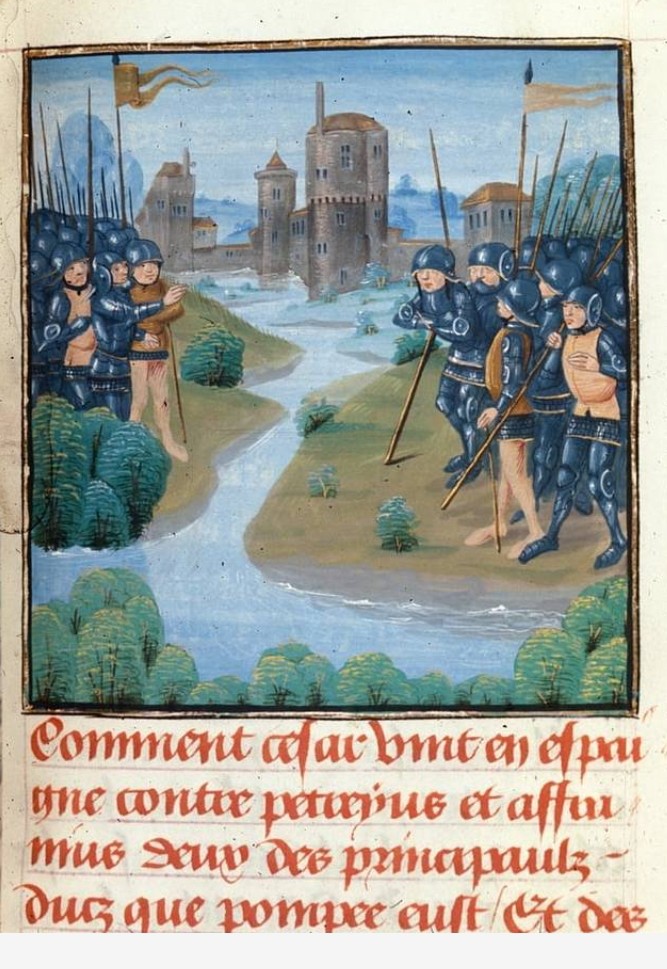 |
| The battle of Ilerda, from BL Royal MS 17 F ii, f. 211 |
[Image source: https://picryl.com/media/battle-of-ilerda-from-bl-royal-17-f-ii-f-211-2178d4 . It's a 1479 manuscript of La grande histoire Cesar made for Edward IV in Bruges. For a lively account of the MS, see Scot McKendrick's paper: https://www.academia.edu/98034065/La_Grande_histoire_Cesar_and_the_Manuscripts_of_Edward_IV . To simplify greatly, this is an illustrated copy of the French text more commonly known as Les faits des Romains (though in fact the biography of Julius Caesar was the only part ever to be completed), compiled back in 1213-14 from material drawn from Lucan, Suetonius, Sallust and Caesar himself. Not Caesar's civil war commentaries, though (Commentarii de Bello Civili); they were effectively lost until published in 1469 in Rome.]
After all these Penguin Classics volumes of Horace and Livy and Virgil and Cicero and Ovid, I wouldn't mind reading some Roman literature written by women, I thought.
Some hope. I wasn't expecting there to be very much, but I was taken aback to find that, basically, there's nothing at all. Sulpicia's delightful set of six (40 lines). A few lines from personal letters, some skits on Memnon's leg, quotations from the revered Cornelia that are probably fabricated... anyway, you can find the details on Wikipedia.
Disappointing, after Sappho (650 lines); but then 95% of Sappho's own work is lost, despite her fame. (Generally, when it comes to ancient literature, nearly everything is lost.)
Anyway, I was so dispirited that it put me off reading a male Roman putting words into the mouth of Dido or Medea, so instead I went to the other extreme and read Caesar's commentaries on the Civil War, a book in which women are hardly mentioned at all.
Let's go to inner Catalonia in the spring of 49 BCE. (According to the Roman calendar it was June, but the calendar had drifted badly, so it was really more like April; three years later Caesar himself would fix that.)
I found that panic was spreading along almost the whole line -- a state of affairs which I had never expected and to which I was quite unused. Shouting out to the men to stand firm, I brought up the Ninth Legion in support. The enemy had shown a kind of insolent daring in their pursuit, and I put a stop to this. I forced them to turn back and retreat to Lerida, where they formed up outside the walls. But the men of the Ninth, who were full of enthusiasm and determined to make up for the setback we had received, pressed their pursuit rashly and too far. They advanced right up to the hill on which Lerida stands and here found themselves in a difficult position. They tried to withdraw, but it was now the turn of the enemy, who charged down on our men from higher ground. There were steep rocky gorges on each side of them and the space between was only enough for three cohorts to be drawn up in line. Thus it was impossible to give them support on their flanks or to use cavalry to help them when they were in trouble. From the town, however, the ground sloped down gently for about five hundred yards. Our men, whose enthusiasm had unwisely carried them so far, stood facing this slope, fighting in a most unfavorable position. They had no room to maneuver, and because they had halted at the very foot of the high ground, every weapon directed at them found its mark. Nevertheless they stood their ground, fighting magnificently in spite of heavy casualties. Meanwhile the enemy's strength was increasing; from their camp new cohorts were constantly being sent through the town into the fighting line so that fresh troops could relieve those who were tired. I was obliged to do the same thing and sent up other cohorts to take the places of my own exhausted men.
In battle things could so easily go amiss. The fighting continued for five hours before Caesar's troops could withdraw, having nothing to show for their efforts but proof of valour. And then nature intervened:
The enemy now built strong defense works around the hillock for which the fighting had taken place, and manned them with a garrison. We also suffered an unforeseen misfortune within two days from the time of the battle. There was a tremendous storm which brought with it more rainfall than had ever been known in these parts. At the same time, the snows were washed down from the mountains, so that the river overflowed its banks and in one day both of the bridges that Fabius had built were swept away. The result was that we were placed in a very difficult position.
As has already been explained, our camp was between the two rivers Segre and Cinca, which were about thirty miles apart. Neither of these rivers could be crossed, and so we were forced to remain in this confined space. The states which were on friendly terms with us were unable to send us grain; some of our own people, who had gone out for quite a distance to bring in supplies, were cut off by the floods and could not get back; and the large convoys of provisions coming from Italy and Gaul could not reach the camp. It was also the worst possible time of the year. There was no grain left in the winter stocks, and the new harvest was not quite ripe. ...
(from Julius Caesar, Commentarii de Bello Civili, I.6, translated by Rex Warner (1960).)
*
In online discussions the topic of truth is apt to come up. Take him with a pinch of salt, readers advise. History is written by the victors, they intone. It was propaganda for the Roman public.
But I don't think Caesar's commentaries are a special case. Surely we take every autobiographical narrative with at least two generous pinches of salt: one, because people never understand themselves; two, because they want to show themselves in a particular light.
As for the victors meme, well, the dead tell no tales, it's true. But not all survivors are victors. Much history is written by bystanders. Losing causes, too, are kept alive for generations by transmission of history, true or false. The vast majority of people leave no account of anything. The conditions that have left us, for instance, with no witness by Roman women.... you can't boil that down to an idea about victors and losers.
And as for propaganda, it was childishly rudimentary in Caesar's time. The great age of propaganda is our own age. To really control the narrative, we first needed mass media, we needed theories of government and commercial advantage, we needed to invent the faceless legal entities of nations, institutions, companies and foundations, we needed advanced technologies of marketing and advertising and information processing, and above all we needed to cultivate social habituation to an absence of integrity, until it wasn't even seen....
*
We can speculate endlessly about what suppressions or misrepresentations there might be, but the striking thing in Caesar's account of his campaigns is its honesty. Part of that is, indeed, about being the eventual victor. Once you've won at Lerida or Pharsalia you can be frank about difficulties and changes of plan along the way; the frankness confirms your strength.
But the more important reason is Caesar's belief that honesty with oneself is essential to good generalship. So in Caesar's accounts of his campaigns, the gods are entirely absent. The enemy is just the enemy; moral judgments are a weapon of negotiation, not something to be credited in the field. Emotion is an element to be reckoned with; the power of emotion, both for good and ill, fascinates Caesar, but it mustn't sway a general's decisions. Inevitable ignorance is another element: sometimes you can't understand what your opponent is up to, and you just have to work with that. Local conditions are another; when they change, a good plan may have to be given up. Chance is another, and it can go against you, but ill fortune shouldn't affect your confidence; it was still a good plan, even if the execution went all to pot. Nor should good fortune lead to over-confidence, but clearly be seen for what it was; an unmerited slice of luck. Caesar does just that, when a lucky change of wind direction allows his fleet to escape almost certain destruction. Pompey, by contrast, grows dangerously over-confident when Caesar's troops get confused about the topography at Dyrrachium, rush down a blind alley and panic themselves into a defeat that Pompey's forces really had very little to do with. The commentaries are a manual for clear thinking, and a pretty good textbook for generals and football coaches alike; I think Caesar enjoyed that educational aspect as much as any.
*
1. Well, my first recommendation is, read Rex Warner's translation (War Commentaries of Caesar, 1960). Most of the translations online are terribly dreary, but this one is dramatically different. You can read it on the Internet Archive:
https://archive.org/details/warcommentarieso00caes/mode/1up
Warner turns the third-person narrative into the first person; you'll be bothered by that for a page or two, and then forget about it. He drops Caesar's use of the historic present, and all the close-packed compressions of Latin. He uses modern place-names, so you don't have to constantly remind yourself that Massilia is Marseilles and Ilerda is Lerida*, or that the Sicoris is the Segre and the Hiberus is the Ebro. The modern names must seem kind of weird if you're a historical etymologist but for the rest of us, suddenly, these are places that exist in our own world. The ninth hour becomes "about two thirty p.m." and the third watch becomes "about midnight". Warner freely adds words like "simply" or "personally" in the places where an English-speaker of 1960 would naturally use them. In short, it's radically a translation: it's about conveying what Caesar meant rather than the way he said it.
*Although that's actually a bit ironic, because in the post-Franco era the Spanish name Lérida has come to be viewed unfavourably, and most people use the Catalan name Lleida.
2. But sometimes you'll want to check just how far Warner has diverged or expanded. And then it's useful to see the Latin text alongside the fairly literal translation by A. G. Peskett (Loeb, 1914):
https://archive.org/details/civilwarswitheng00caesuoft/page/n10/mode/1up
3. Anthony Trollope is an entertaining reading-companion. You can read his book-by-book account of Caesar's commentaries here; it isn't a translation but a series of chatty summaries, forceful opinions and acute reflections. (Trollope the novelist shares Caesar's fascination with how people think and how they make decisions -- or fail to make them.)
https://www.gutenberg.org/files/55926/55926-h/55926-h.htm#CHAPTER_IX

Labels: Anthony Trollope, Julius Caesar
Permalink posted by Michael Peverett @ 12:09 pm
0 comments