Monday, December 24, 2012

Troglodytes troglodytes (Eurasian Wren)

As I was crossing from the overflow car-park I saw a wren flit down onto the access road. I walked another step, looked again, and HEY WHAT? it had completely disappeared.  Then I realized that it had landed more or less on a grating in the road surface.

It can't have gone down there, can it? I thought. I stopped and watched, and sure enough, about 15 seconds later it popped back up and skittered into the undergrowth.

I've since discovered that this caving habit is well-known (except to me, apparently) and it is the explanation for the generic name Troglodytes.

It also helps to explain why wrens can live high up on the slopes of Snowdon in winter. Wrens are insectivores, but crevices are good places not only for shelter but  for finding insects and spiders out of season.

Labels:

Wednesday, January 11, 2012

birds singing at night.

It was Dec 22nd when I first heard it, at around 3 am, i.e. around 5 hours before sunrise. It was a sleepy sort of hushed chorus of low tweeting, evidently a whole treeful of birds and of several species. It consisted of twittering rather than full song. At one point even a crow chimed in, possibly saying "shut the fuck up".

And I've heard this middle-of-the-night singing several times since I moved back to Frome, where my bedroom backs onto waste ground with trees and a railway, always at around 2-4 a.m. Perhaps it has always been there but I never noticed it until I moved back from my six months sojourn at a house in West Swindon where there was practically no birdsong because there happened to be no trees near to my window. (West Swindon, I want to emphasize, is on the whole a distinctly treeish place.)

This seems to be well-known behaviour. Usually it is robins (some people have speculated that urban robins are confused by light pollution).

It particularly occurs around the winter solstice.

So Marcellus, in Hamlet, was reporting a genuine midwinter phenomenon:

Some say that ever ‘gainst that season comes
Wherein our Savior’s birth is celebrated,
The bird of dawning singeth all night long;
And then, they say, no spirit dare stir abroad,
The nights are wholesome, then no planets strike,
No fairly takes, nor witch hath power to charm,
So hallowed and so gracious is the time.

Perhaps, too, it has some connection with T.S. Eliot's mysterious "midwinter spring".

The other noises I often hear are foxes barking (e.g. last night around 23:30) and the whistling of Little Owls (but generally not at this time of year). The trains make loud shrieking and grinding noises, which I usually sleep through. At some time between 05:45 and 06:30 my Polish neighbour drives off in his van, so that I begin every day feeling like a lazy git.

Labels:

Thursday, July 16, 2009

herons and rooks

"It has been statistically proven that there are more common birds than there are rare birds", lamented Bill Oddie during a dull week-end's birding. He also noted that some particularly rare and spectacular species seem to only ever show themselves to non-birdwatchers. To a certain extent I can now vouch for this.

e.g. I'm getting really bored with great white egrets. On Tuesday I was at Climping Beach in W Sussex and I looked up and there was a big white heron flying above me. But I've already seen another one this year; it was fishing in a pool near the mouth of the River Brue at Highbridge. I don't really know much about birds. I can't tell a missel thrush from a song thrush, (I can't even spell mistle), and for anything I know to the contrary warblers are a purely fictional kind of bird. So why am I dogged by birds that aren't even in the birdbook?

This must be a good confident time for herons. Was the time, not so long ago neither, when the grey heron was so timid that it flapped wearily out of a stream the moment you even had a passing memory of that stream, even though you lay at the time in foreign custody and had not been near the stream for twenty years,... anyhow, these same herons are now so insensible that they snooze hunched up while we trudge past them, though barely 6 feet away on the far side of a ditch.

On the way home we still had an end of stale loaf that had been intended for ducks, but we hadn't met any ducks. I thought I would try feeding it to some rooks who were pecking at a strip of turf beside the motorway services. Only one or two were in range. They were surprised and extremely suspicious, but couldn't resist snatching the bits I had managed to chuck furthest. There was a fairly clear message of "No-one's ever done this before, are you sure you wouldn't rather shoot us and hang us upside-down from a gibbet?" Rooks close to have a very disneyish appearance with a sort of Mersey cut and a cartoon conk. When I had finished casting stale bread and I walked away, about forty rooks descended in a joyous squabbling mass, in which I could still distinguish a faint note of incredulity.

Labels:

Friday, April 06, 2007

mercuries / mallard

Mercurialis perennis (Dog's Mercury or Perennial Mercury)

This is the plant, inconspicuously flowering now, that carpets woodland floors in spring with energetically green leafage. These leaves are in opposite pairs and are ovate-lanceolate, acute, slightly downy on both sides and neatly serrate; successive leaf-pairs are set more or less at right-angles to maximize absorption of the early light in the woods.

M. perennis is dioecious: different clumps of plants are either male or female. In fact these clumps are usually all one plant, though the smaller vertical stems may not produce any flowers. Underneath the ground surface each apparently separate plant is seen to spring from a horizontal white rhizome , several inches long and the same breadth as the vertically ascending stem. Trace the rhizome back to its source and you arrive at the real heart of the matter, a network of tough nodes with strong, cord-like roots.

Dioecious plants are always interesting since the set-up of separate male and female individuals, relatively unusual in the plant world, is the norm for us animals. Plants of both sexes produce their flowers on axillary stems arising above a pair of leaves. The male flower-stems are much longer. One naturally looks for secondary sexual differencebut these are few: while the female plants must sustain fruit until maturity they have far fewer flowers. The essential distinction is about timing; the male effort is now, the female effort comes later. Therefore at this moment the female plants look slightly fresher, neater, healthier, with more rounded leaves and stronger stems. They still hold something back.

Mercurialis annua (Annual Mercury)

This is a scruffy plant, but that may be because its preferred habitat is the dog-tousled verges of urban pathways; it's quite likely not native to the UK and you never seem to find it far from human disturbance. Being an annual, each plant is separate and has its own mop of fibrous roots. The leaves are smaller and less toothed, paler green and nearly hairless; the main stem is branched, producing many more flowers. This species too is dioecious; a surprising arrangement for an annual plant where successful reproduction is so critical, but not all that unusual among wind-pollenated annuals (including cannabis and spinach). Every individual bears flowers; the ones that appear to be non-flowering are females, whose flowers are on very short stems. Since both flowers and leafing side-branches are produced from axils of the main stem, these nodes can be quite crowded, like spaghetti junction. The aerial form of this plant bears an analogy to the undergound parts of the perennial species.


(Mercurialis annua: male plant on the left, female plant on the right. Taken in central Bristol in December.)


Anas platyrhynchos (Mallard or Wild Duck)

Mallards look sweetly peaceful when they pair up at this time of year. In fact their mating behaviour is not always very sweet. I was once watching a duck and drake foraging quietly in a wood when another drake came out of the sky, and forcibly mated the duck while the other drake stood helplessly by. I have also seen a duck incessantly chased by a group of drakes, cornered exhausted between jetties of a reservoir and mounted by each of them in turn.

That was on the water. Also on the water, I saw a drake mount a duck (during mating the duck is almost under water, but for her head which is gripped in the drake's bill). Another drake took exception to this and leaping on the back of the first drake, tried to force his head beneath the surface. Eventually the attacked drake struggled free and fled with the other in brief pursuit, but in the meanwhile the unfortunate duck, three layers deep, was forgotten and its body then re-emerged on the surface, tail and feet up, drowned.

The life of the mallard being so visible to us, humans often witness these scenes and worry about them; to describe them, using words like "gang-rape", "murder", etc. We accept inter-species violence, e.g. of predators on prey, but intra-species violence is more unnerving. Theologically, is there evil in the animal world too? Generally, these outrages occur near the end of the pairing season when most ducks are mated and reclusively nesting. The few remaining ducks in the open are then at risk from a preponderance of unpaired drakes. One looks for the corrupting hand of man in this and it may be that we exacerbate the situation by feeding up the largely-male groups with stale bread in the warmer days of spring, increasing the weight and strength of frustrated males. Besides, these semi-domestic mallards of our parks and urban waterways are often genetically mixed with domestic breeds such as the Barbary Duck grown for extra size, increasing the risk of drowning during aquatic mating. Zoologists will go so far as to surmise that the mallard is an object-lesson in the different, and often conflicting, reproductive motives of the sexes.

Labels: ,

Wednesday, April 26, 2006

corvidae

For a moment it seemed like a battle of wills. The crow was in the road ahead, pulling a string of red flesh out of the squirrel, showing every sign of serene preoccupation. I wondered whether I'd have to slow down. At the last second the crow made a couple of lazy flaps to the side of the road. By the time I could fix him in my rear-view mirror, he was back on his food.

It's surprising how rarely you see a squashed crow (or rook or magpie or jackdaw). But what really impresses me isn't their road safety record as such - good as it is, they probably get run over more often than humans. What's really impressive is that it's so good even though they seem completely unaware that eating your food on the public highway puts you in danger.

When human beings don't know they're in danger, it usually means something bad's about to happen. - which is why you never take your eye off your toddler in the street. The toddler hasn't yet learnt about all the anxiety and mental tension that's required to be safely around road traffic, so we have to do that part for her. The crow seems to be in the same blissfully anxiety-free state as the toddler, - only the crow doesn't seem to get killed.

I suppose crows just instinctively take flight when any large object comes into their personal space. They couldn't not do it if they tried, and it probably doesn't even break their train of thought. So danger doesn't really come into it..
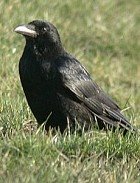


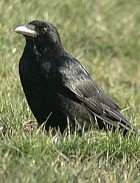
Still, granted that this wonderful road-sense is mainly just blind instinct, the behaviour of these Corvidae keeps reminding me - disquietingly, in a way, - of human beings. They seem intelligent and they seem intelligent in a human kind of way, if you see what I mean.

I think this must be related to their scavenging, opportunistic way of life. There are birds, like kestrels, who go out and make things happen. Kestrels are fine-tuned and ultra-skilled, but you sense they lack mental elbow-room.

Crows don't make things happen; mostly, they sit around waiting for someone else to make something happen. With a reporter's nose they have to develop a sense of when and where that might be. They watch the world in an unexclusive manner. When they see something, they have to decide if it could be good for them. These kind of fuzzy deliberations are one of the things about crows that remind me of humans.

And then, there's the social side. That's two-fold. First there's all that waiting, which promotes leisure and company. Secondly, when the nutritious event occurs there's often too much food for one individual. Crows don't usually need to be secretive and jealous, in fact have developed many tolerances. You can imagine their gallows humour, hunched over a bar fire.
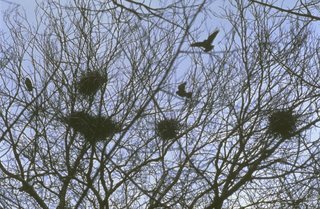


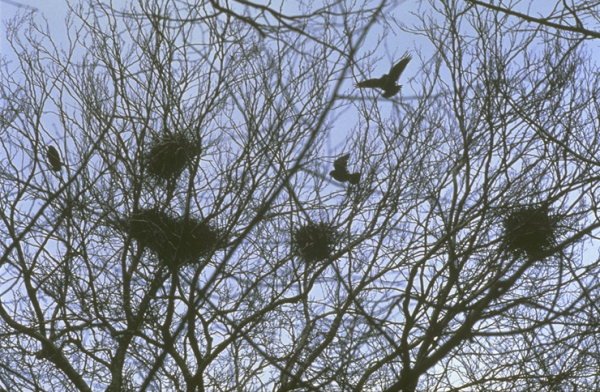
Watching a blowy rookery as the light dims is a joyous sight. There is nothing alternative about a rook's lifestyle, so far as I know. But these very conventional families love to live all over each other and to roam loudly back and forth on pointless trips. It's like watching a housing estate with all the roofs off, or like when we stay on a campsite. Then, the trampled grass lanes, the streetlife that we spontaneously create as we join each other's barbecues - yes, that in particular reminds me of a rookery.

Labels:

Powered by Blogger