Sunday, November 20, 2022

All tendrils green

Diana und Endymion, 1836 painting by Franz Schrotzberg.

[Image source: https://useum.org/artwork/Diana-und-Endymion-Franz-Schrotzberg-1836 . In the Belvedere, Vienna.]


                                and round him grew
All tendrils green, of every bloom and hue,
Together intertwin'd and trammel'd fresh:
The vine of glossy sprout; the ivy mesh,
Shading its Ethiop berries; and woodbine,
Of velvet leaves and bugle-blooms divine;
Convolvulus in streaked vases flush;
The creeper, mellowing for an autumn blush;
And virgin's bower, trailing airily;
With others of the sisterhood.

(Endymion II, 409-418)

I'm reading Endymion, again. 


The passage I've just quoted is from Keats' description of the sleeping Adonis in Book II of Endymion. It  lists a number of species of climbing plants. As often, Keats' description suggests closely-observed London gardens of his own times. It is, in fact, just what Lockhart criticized as "laborious affected descriptions of flowers seen in window-pots". But Lockhart didn't see (or did he?) that precisely this urban mundanity, its willingness to acknowledge what it really saw, marked out the path of Keats' intervention into a poetic culture that had become stultified and unreal. 

The vine of glossy sprout : That is, the grape vine, Vitis vinifera. The leaves are "glossy dark green on top, light green below, usually hairless". 

The ivy mesh, Shading its Ethiop berries: Ivy, Hedera helix. Mesh: woven. The winter berries are green turning blue-black.

Woodbine : Honeysuckle, Lonicera periclymenum. Each flaring flower does somewhat resemble a trumpet or "bugle", perhaps a visual fanfare as they point out in different directions from the common flower head. 

Convolvulus: Climbers of the bindweed family, their flowers could be described as vase shaped, and the garden varieties are often streaked.

The creeper, mellowing for an autumn blush: Virginia creeper, Parthenocissus quinquefolia, whose leaves turn red in autumn. Native to America, introduced into Britain in 1629. 

And virgin's bower, trailing airily: Clematis: "trailing airily" probably refers to the stems seeming to defy gravity by venturing out into mid-air (actually sustained by the clasp of other stems). 

The horticulture is Keats' own, but the general idea of Adonis sleeping among tendrilled plants came from Spenser:

And in the thickest couert of that shade,
  There was a pleasant arbour, not by art,
  But of the trees owne inclination made,
  Which knitting their rancke branches part to part,
  With wanton yuie twyne entrayled athwart,
  And Eglantine, and Caprifole emong,
  Fashiond aboue within their inmost part,
  That neither Phœbus beams could through the throng,
Nor Aeolus sharp blast could worke them any wrong.

(Faerie Queene, III.VI. 44). 


Keats kept Spenser's ivy and the honeysuckle ("Caprifole"). He had a different use for the rose. Let's put that initial quotation back into its context.  

And down some swart abysm he had gone,
Had not a heavenly guide benignant led
To where thick myrtle branches, 'gainst his head
Brushing, awakened: then the sounds again
Went noiseless as a passing noontide rain
Over a bower, where little space he stood;
For as the sunset peeps into a wood
So saw he panting light, and towards it went
Through winding alleys; and lo, wonderment!
Upon soft verdure saw, one here, one there,
Cupids a slumbering on their pinions fair.
After a thousand mazes overgone,
At last, with sudden step, he came upon
A chamber, myrtle wall'd, embowered high,
Full of light, incense, tender minstrelsy,
And more of beautiful and strange beside:
For on a silken couch of rosy pride,
In midst of all, there lay a sleeping youth
Of fondest beauty; fonder, in fair sooth,
Than sighs could fathom, or contentment reach:
And coverlids gold-tinted like the peach,
Or ripe October's faded marigolds,
Fell sleek about him in a thousand folds–
Not hiding up an Apollonian curve
Of neck and shoulder, nor the tenting swerve
Of knee from knee, nor ankles pointing light;
But rather, giving them to the filled sight
Officiously. Sideway his face repos'd
On one white arm, and tenderly unclos'd,
By tenderest pressure, a faint damask mouth
To slumbery pout; just as the morning south
Disparts a dew-lipp'd rose. Above his head,
Four lily stalks did their white honours wed
To make a coronal; and round him grew
All tendrils green, of every bloom and hue,
Together intertwin'd and trammel'd fresh:
The vine of glossy sprout; the ivy mesh,
Shading its Ethiop berries; and woodbine,
Of velvet leaves and bugle-blooms divine;
Convolvulus in streaked vases flush;
The creeper, mellowing for an autumn blush;
And virgin's bower, trailing airily;
With others of the sisterhood. Hard by,
Stood serene Cupids watching silently.
One, kneeling to a lyre, touch'd the strings,
Muffling to death the pathos with his wings;
And, ever and anon, uprose to look
At the youth's slumber; while another took
A willow-bough, distilling odorous dew,
And shook it on his hair; another flew
In through the woven roof, and fluttering-wise
Rain'd violets upon his sleeping eyes.


In Spenser's poem the arbour on the mount of Venus is erotic anatomy, shaded by interlaced foliage. The eroticism in Keats' poem is more incessant and dispersed, a longing that hardly ever rests in satisfaction.

John Gibson Lockhart, on the unclassical nature of Keats' Endymion -- the famously vicious review in Blackwood's Edinburgh Magazine (August 1818) -- a thoroughly ugly performance, as all Keats' admirers observed, but, read in full, it is not quite so disrespectful as it's reputed to be.


[Lockhart was apparently assisted in his assaults on the "Cockney School" by John Wilson (Christopher North). William Michael Rossetti (in his excellent Life of John Keats, 1887) mentions a rumour that "Scott himself lent active aid in concocting the articles". But this rumour didn't even attract John Sutherland (The Life of Walter Scott: A Critical Biography, 1995), who noted that Scott was nervous about Lockhart's enthusiasm for the Blackwood's style of "brutal personal satire", and warned him against it.]

Lockhart hints, nastily enough, at the lubricious side of Endymion. But more to the point were Keats' incautious statements, especially in the Poems of 1817, which showed his ambition to match himself, and his friends, with the greatest English poets. That created a vulnerability exploited by Lockhart, who pointed out that after all Leigh Hunt was very far from a great poet, and that someone who couldn't discriminate in value between Wordsworth and Hunt was self-condemned as completely out of his depth. Yet in a way Lockhart, by even mentioning Keats' vaulting ambitions, began to cede ground to him, as readers have done ever since. There has been a tendency to accept as a given Keats' presence among the greatest poets, because he so openly and seriously aimed at it; to assume that, though of course he did not triumph at first, he did triumph in the end. And while I love Keats very much, I think that's unfair to so many other poets and to so many other kinds of poetry. This talk of greatness was wrong, in the way that publicity is always wrong. (Lockhart's review is of course the kind of thing that makes people say there's no such thing as bad publicity.)

Keats had tweaked the tail and Lockhart replied in kind; they were both aggressive in their ways. (Keats' aggression would have been more open if his first version of the Preface had been allowed.) Lockhart's meanness was disgraceful. Keats was not mean, but it was he who provoked this kind of response. 

Keats was quite self-consciously unclassical, even though he saw Endymion as touching "the beautiful mythology of Greece" (Preface). Think of his curt dismissal of the matter of Troy, which he compared unfavourably with the medieval story of Troilus and Cressida; meaning Chaucer's version (Book II, 1-43). "Hence, pageant history! hence, gilded cheat!" Keats was both incredibly passionate and knowledgeable about Greek mythology and at the same time dedicated to a different way of accessing that mythology, different from the curriculum of a classical education; he saw that he could say things that people with a classical education would never say; they were too comfortably moulded to reflect on poetry or on life or on myth with the same freshness he brought to it. There was a boldness to his dedicating Endymion to Chatterton. Patently, Keats was intent on being a thorn in the side of orthodox literary culture. 

Endymion very evidently didn't have Spenser's music, but its own; an awkward heroic couplet that was completely unlike the Augustan measure, that revelled in being "nerveless" (Lockhart's word) i.e. in not being firmly Popeian or clinching but, as a direct consequence, capable of generating new surprises. Yet it also seems to me to be Spenserian in quite a deep way; a combination of tedium and excitement, for instance. But it isn't so much the Spenser of The Faerie Queene that I'm thinking of; which was a narrative poem through and through, in ways that Endymion isn't; it's more the Spenser of, say, The Shepheardes Calendar

*

In "I Stood Tiptoe", Keats had called the story of Endymion "That sweetest of all songs, that ever new, / That aye-refreshing, pure deliciousness". One might naturally assume that Keats was talking about a particular literary treatment of the story; but no such treatment survives from classical times. Keats certainly knew the accounts of Endymion in the much-reprinted classical dictionaries of his time. Very suggestive they might be, in a poet's eyes, but they are scarcely the "sweetest of all songs".  


ENDῨMION, a shepherd, son of Æthlius and Calyce. it is said that he required of Jupiter to grant to him to be always young, and to sleep as much as he would ; whence came the proverb of Endymionis somnum dormire, to express a long sleep. Diana saw him naked as he slept on Mount Latmos, and was so struck with his beauty that she came down from heaven every night to enjoy his company. Endymion married Chromis, daughter of Itonus, or according to some, Hyperipne, daughter of Arcas, by whom he had three sons, Pæon, Epeus, and Æolus, and a daughter called Eurydice ; and so little ambitious did he show himself of sovereignty, that he made his crown the prize of of the best racer among his sons, and honorable distinction which was gained by Epeus. The fable of Endymion's amours with Diana, or the moon, arises from his knowledge of astronomy, and as he passed the night on some high mountain, to observe the heavenly bodies, it has been reported that he was courted by the moon. Some suppose that there were two of that name, the son of a king of Elis, and the shepherd or astronomer of Caria. The people of Heraclea maintained that Endymion died on mount Latmos, and the Eleans pretended to shew his tomb at Olympia in Peloponnesus. Propert. 2, el. 25. -- Cic. Tusc. 1. -- Juv. 10. -- Theocrit. 3. -- Paus. 5, c. 1. l. 6, c. 20.

(Bibliotheca Classica by John Lemprière, Eleventh Edition (1820), pp. 275-276. Source .)

This Luna had a lover who was named Endymion, and he was courted by her, insomuch, that to kiss him, she descended out of heaven, and came to the mountain Latmus, or Lathynius, in Caria; he lay condemned to an eternal sleep by Jupiter; because, when he was taken into heaven, he attempted to make love to Juno. In reality, Endymion was a famous astronomer, who first described the course of the moon, and he is represented sleeping, because he contemplated nothing but the planetary motions.

(Tooke's Pantheon, Baltimore edition of 1838, p. 210 Source .)

What Keats was really thinking of was Endymion as he figured in English poetry of the Elizabethan age, as Sidney Colvin made clear in his  Life of John Keats (1887). Keats would certainly have known some spell-binding Elizabethan lines on the Endymion story, e.g. in Spenser's Epithalamion, Shakespeare's The Merchant of Venice, and Fletcher's Faithful Shepherdess (like other readers of his time, Keats was a major fan of Beaumont and Fletcher). There were plenty of other treatments too, beginning with Lyly's Endimion (1588). 

And then there was Michael Drayton. Keats himself owned a 1636 edition of Drayton which included The Man in the Moone, one of his two poems about Endymion. 

In some ways the closest analogue to Keats is Drayton's earlier poem Endimion and Phoebe (1595); but this had never been republished and Keats must have been very diligent to track down a poem surviving in only two copies. 

If you want to check it out for yourself, then Endimion and Phoebe is on pp. 197-227 of J. Payne Collier's 1856 edition of Poems by Michael Drayton. The resemblances are quite striking: for instance  Drayton introduces Phoebe, in disguise, wooing her lover away from herself; a storyline that naturally suggests Keats' Indian Maid. But the differences are quite striking too. Drayton's Endimion is a shepherd with a flock of sheep, but Keats' shepherd-prince has no flock to watch over; he is conceived principally as a huntsman, a "mountaineer", a "forester" and, after I 486 never makes the slightest reference to sheep. Also, Endimion and Phoebe is an erotic epyllion on the model of Venus and Adonis : so Drayton's maid is "wanton", and Endimion is correspondingly reluctant (at first), being vowed to chastity as a follower of Diana. Keats' Endymion isn't reluctant in the least. 

Keats wrote to Benjamin Bailey (8th October 1817) that Endymion was ‘a text, a trial of my Powers of Imagination and chiefly of my invention ... by which I must make 4000 lines of one bare circumstance and fill them with poetry’. He was right about the "one bare circumstance". The Endymion myth had accreted some fabulous lines of poetry in the 1590s but it didn't really have much of a plot; it was just a situation. (Drayton and Keats came up with similar ways of elaborating a bald tale that was bereft of characters and drama: each produced the semblance of an intrigue by having Phoebe take a part against herself. I can believe they did so independently.)

[Maybe these Elizabethan sources of the Endymion story also account for the not obviously apposite invocation of the "muse of my native land" at the beginning of Bk IV; Keats was acknowledging that his Endymion was in some ways more English than Greek. (There was Endymion literature elsewhere in Renaissance Europe too, but Keats seemingly didn't know of it, though he might have been interested in Marino hailing Galileo as a "new Endymion".)]


Natalia Agapiou "Endymion at the Crossroads: The Fortune of the Myth of Endymion at the Dawn of the Modern Era", 2004, Res Publica Litterarum: Studies in the Classical Tradition


Claude L. Finney, "Drayton's Endimion and Phoebe and Keats' Endymion", PMLA Vol. 39, No. 4 (Dec., 1924), pp. 805-813.


*

Bruce E. Miller, "On the meaning of Keats's 'Endymion'", Keats-Shelley Journal
Vol. 14 (Winter, 1965), pp. 33-54


Discusses two lines of interpretation (is Endymion about spiritualized union with essence or about natural and physical love) and makes a detailed case for a coherent narrative that charts a progress from the sensual encounter with what he calls "the nympholeptic goddess" in Bk II 707-853 through the romantic relationship with the Indian Maid to, ultimately, the celestial union with Phoebe. 

The contrast between the sustained eroticism in Bk II and the much cooler temperature of the Indian Maid section in Book IV is undeniable and calls for explanation. But I think it is sufficiently explained by the entirely different situations. The "naked waist" of Book II, the "known Unknown", is only unknown as regards her name; Endymion knows her very well to be his declared lover, and their embraces are immediate and unrestrained. On the other hand, when Endymion sees the Indian Maid in Bk IV he believes she is a stranger to him; a lover in distress, like those Endymion had helped to save in Bk III. Endymion falls for her, but neither he nor she (playing the part of a stranger) can instantly give way to ecstatic transports of the kind seen in Bk II; nevertheless, they are moving pretty fast in a sexual direction (IV. 313-320) when interrupted by the cry of Woe! and the appearance of Mercury. Thereafter the expression of their love is muted by consciousness of the obstacles. 

*

Christian La Cassagnère, "Keats's Gleaming Melancholy: A Reading of Endymion" (2006)


An interesting and quite persuasive track through Endymion, seeing it as unified by the theme of melancholy; placing special emphasis on some of the most confusing elements of Bk IV, such as the Indian Maid's roundelay on sorrow and the passage about that "den" of "remotest glooms" the Cave of Quietude (and the excellent quality of sleep that may be obtained there). This proposal relates Endymion to the later Ode on Melancholy, and also to Lamia (based on Burton's Anatomy of Melancholy).

*

Chris Townsend "Keats's Verse Sentences in 'Endymion'"


Brief but suggestive, connecting the peculiar verse form of Endymion with its topography of paths and getting lost. 


*

I've already mentioned W.M. Rossetti's Life of John Keats. But it's worth adding that it contains an admirable review of both the merits and the faults of Endymion (pp. 168-180). His strictures on Book IV, in particular, gave me plenty of food for thought. 

He includes an attempt to summarize the action of the poem, something I've also tried my hand at: 

Neither he nor I were attentive enough, I feel, but that's very understandable. A summary must select, but while the story of  Endymion is from one point view rather static, the poem Endymion is ceaselessly active. It isn't easy, when reading it, to decide what to highlight and what to leave unreported, because Keats noticeably avoids the kind of signals that allow a reader to distinguish between, say, a principal narrative line and a digression. To offer just one example, Endymion is repeatedly shown as sleeping or on the verge of sleep. Are these sleeps just a handy device for switching from one scene or vision to the next, or is Endymion's sleepiness (as per Lemprière) a principal fact about him and his story? Is e.g. his immersion in the Cave of Quietude (from which nothing material seems to follow) to be regarded as an important part of his story or not? 

As we have seen, Keats, when well advanced with this poem, spoke of it as a test of his inventive faculty: and truly it is such, but I am not sure that his inventive faculty has come extremely well out of the ordeal. The best part which invention could take in such an attempt would be a vigorous, sane, and adequate conception of the imaginable relation between a loving goddess and her human lover; her emotion towards him, and his emotion towards her; and his ultimate semi-spiritualized and semi-human mode of existence in the divine conclave; along with a chain of incidents—partly of mythologic tradition, partly the poet’s own—which should illustrate these essential elements of the legend, and take possession of the reader’s mind, for their own sake at the moment, and for the sake of the main conception as ultimate result. Of all this we find little in Keats’s poem.

It's quite a powerful argument. In Rossetti's era of the dramatic monologue, or in our own era of Madeline Miller, it seems rather obvious that the way to turn "one bare circumstance" into a full-length work is to attempt an in-depth realization of the leading characters, to shape them into individuals, and to seek ways of portraying the love of a human and an immortal as something credible or at least conceivable. 

But it's an argument that can be answered, in part at least. For Keats and indeed for most poets up to his time, poetry had never been about realism. Keats in particular did not want to demythologize the Endymion story; it was the myth that he wanted. Keats' invention was indeed hyperactive, but it was deployed rather in creating the effect of "richly-shot silk" that Rossetti describes so well. What the reader was to share was not the plausibility of the story but its strangeness.  

*


On Erik Johan Stagnelius' "Endymion":


Labels: , , , , ,

Monday, August 29, 2022

Notes on "I Stood Tiptoe..."


Part of Keats' draft of "I Stood Tiptoe..."

[Image source: https://www.hamhigh.co.uk/news/fragment-of-keats-poem-sells-for-world-record-breaking-price-3444706 . Charles Cowden Clarke cut Keats' draft into thirteen fragments and distributed them to friends. This particular fragment sold for £181,250 in April 2013. See end of post for an image of both sides of the fragment. The side shown above is lines 181-195 (the beginning of the Endymion section); on the other side is lines 157-173 (Syrinx and Narcissus).]

[Keats calls the story of Endymion "the sweetest of all songs", something I discussed in another post: 

https://michaelpeverett.blogspot.com/2022/11/all-tendrils-green.html .]


The poem we call "I Stood Tiptoe" had no title when it opened the Poems of 1817. Keats himself seems to have referred to it as "Endymion", until he conceived his larger poem. 


Leigh Hunt says "this poem was suggested to Keats by a delightful summer-day, as he stood beside the gate that leads from the Battery of Hampstead Heath into a field by Caen Wood" (Lord Byron and Some of his Contemporaries (1828), I, page 413). In fact the references to violets, bluebells, hawthorn, laburnum, etc generally imply a day in mid-May.  However there's some intrusion from slightly later flowering seasons; honeysuckle, and especially evening-primrose. (Keats is usually said to have begun the poem in Margate in August 1816. He completed it in November.)

I stood tip-toe upon a little hill, 
The air was cooling, and so very still. 
That the sweet buds which with a modest pride 
Pull droopingly, in slanting curve aside, 
Their scantly leaved, and finely tapering stems,       
Had not yet lost those starry diadems 
Caught from the early sobbing of the morn. 
...
So I straightway began to pluck a posey 
Of luxuries bright, milky, soft and rosy. 

(Lines 1-7, 27-28. Text from Poems (1817), by John Keats, on Project Gutenberg:

https://www.gutenberg.org/files/8209/8209-h/8209-h.htm  .  I've yet to track down an image of this page in the original 1817 edition, so I don't know if the full stop at the end of line 2 is an old mistake or a new one.)


Keats doesn't name the plant with the "sweet buds", nor is it clear if his "posey" is a literal one and refers to the same plant. But taking them both together, I'm thinking of Wood Anemone (Anemone nemorosa), whose stems taper and have only a single pair of leaves. Also, the buds "pull droopingly", though the stems become erect when the flowers open fully. It's one of the common spring plants that you might well be inclined to gather a posy of, and "milky, soft and rosy" could describe the petals, flushed with pink on the outside. 

The buds are still dewy; dew is one of the images that keeps recurring in Keats' early poems, like the moon and swans. The poem begins here, well before noon presumably. By line 107 it will reach evening, but this is not a steady progress through a day. Neither time nor place stay fixed for very long. There is a fitfulness and spontaneity to Keats' early poetic; he writes about writing narrative, but he doesn't do it. Anbd there's a basic incompleteness to all the poems in Poems 1817. With Endymion he set about writing something complete: and he duly completed his task, but immediately un-completed the poem with his own dismissive comments on it. 

A bush of May flowers with the bees about them; 
Ah, sure no tasteful nook would be without them;         
And let a lush laburnum oversweep them, 
And let long grass grow round the roots to keep them 
Moist, cool and green; and shade the violets, 
That they may bind the moss in leafy nets. 
 
A filbert hedge with wildbriar overtwined,         
And clumps of woodbine taking the soft wind 
Upon their summer thrones; there too should be 
The frequent chequer of a youngling tree, 
That with a score of light green brethen shoots 
From the quaint mossiness of aged roots:       
Round which is heard a spring-head of clear waters 
Babbling so wildly of its lovely daughters 
The spreading blue bells: it may haply mourn 
That such fair clusters should be rudely torn 
From their fresh beds, and scattered thoughtlessly         
By infant hands, left on the path to die. 

(lines 29-46)

May flowers: Hawthorn blossom. 
Filbert: Hazel.
Wildbriar: Dog Rose. (In contrast with "sweet briar", line 135)
Woodbine: Honeysuckle. Flowering generally starts in June. 
The youngling tree and its light green breth[r]en: "Any body who has seen a throng of young beeches, furnishing those natural clumpy seats at the root, must recognize the truth and grace of this description" (Leigh Hunt in The Examiner).

... Something like this (but these are Sweet Chestnut, not Beech). Powdermill Wood, Battle, 3 September 2022.


Blue bell: The plant now known as Hyacinthoides non-scripta has been assigned to various genera. The fact that one of its names is Endymion non-scriptus is a total coincidence, I suppose: it only acquired that name in 1849 (Garcke). When Keats wrote "I Stood Tiptoe", the bluebell would have been Hyacinthus non-scriptus (Linnaeus, 1753) or Scilla non-scripta (Hofmannsegg and Link, 1803). Torn-up bluebells scattered along a path is still a commonplace sight each spring; they are the kind of plant that attracts childish hands. Like the non-native plants it's a reminder that Keats' nature has a pervasively urban quality. His personification of the spring-head has a certain jocularity, but perhaps also a certain credibility, because it lies so close to a great metropolis. At any rate this image of man's agency will be followed by renewed emphasis on the agency of plants and animals. Nature is all in motion:  marigold flowers spread to the sunlight, sweet peas catch and bind, evening-primrose buds flip open for the moths, minnows switch position in response to a shadow, goldfinches skim over the water to sip and sleek their feathers. 

Open afresh your round of starry folds,
Ye ardent marigolds!
Dry up the moisture from your golden lids,
For great Apollo bids
That in these days your praises should be sung
On many harps, which he has lately strung;

(lines 47-52)

The flowers of Calendula open in bright daylight. The first allusion to the poets mentioned in the epigraph ("Places of nestling green for Poets made") arrives with a couple of trimeters that evoke something like Lycidas; the only other trimeter is line 184, near the start of the Endymion section.

 The tension of the "strung" harps is carried through into the lines about the sweet peas, which like this poet are on tip-toe; we're in fact no longer securely located on the little hill of the opening lines, but are already taking a flight. In the midst of the next scene (the stream with its minnows and sipping goldfinches), Keats says "Were I in such a place" (93). We have been transported to a scene of imagination, not record.


What next? A tuft of evening primroses, 
O’er which the mind may hover till it dozes; 
O’er which it well might take a pleasant sleep, 
But that ’tis ever startled by the leap         
Of buds into ripe flowers; 

(lines 107-111)

A striking phenomenon, if you ever happen to sit beside an evening-primrose plant in the evening. There are various YouTube videos showing the buds "leaping" into flower. Here's one by BocaJoe:


These North American plants had been introduced into Britain in about 1600. Maybe Keats was familiar with them from his apothecary studies. The flowers lead us into twilight, to moths and to another transforming moment, the moon. 

Of buds into ripe flowers; or by the flitting
Of diverse moths, that aye their rest are quitting;
Or by the moon lifting her silver rim
Above a cloud, and with a gradual swim
Coming into the blue with all her light.
O Maker of sweet poets, dear delight
Of this fair world, and all its gentle livers;
Spangler of clouds, halo of crystal rivers,
Mingler with leaves, and dew and tumbling streams,
Closer of lovely eyes to lovely dreams,
Lover of loneliness, and wandering,
Of upcast eye, and tender pondering!
Thee must I praise above all other glories
That smile us on to tell delightful stories.
For what has made the sage or poet write
But the fair paradise of Nature's light?
In the calm grandeur of a sober line,
We see the waving of the mountain pine;
And when a tale is beautifully staid,
We feel the safety of a hawthorn glade:

(lines 111-130)

This is also about agency. Does nature play an active role in making poetry? If nature is evoked when we read, is it evidence that nature also played a part in creating the poetry? Keats thinks so, and after several more lines about the audience's feeling suddenly switches to the author's feeling and finally to the characters' feelings:

When it is moving on luxurious wings,
The soul is lost in pleasant smotherings:
Fair dewy roses brush against our faces,
And flowering laurels spring from diamond vases;
O'er head we see the jasmine and sweet briar,
And bloomy grapes laughing from green attire;
While at our feet, the voice of crystal bubbles
Charms us at once away from all our troubles:
So that we feel uplifted from the world,
Walking upon the white clouds wreath'd and curl'd.
So felt he, who first told, how Psyche went
On the smooth wind to realms of wonderment;
What Psyche felt, and Love, when their full lips
First touch'd;

(lines 131-144)

And flowering laurels spring from diamond vases

I abandon with regret the thought that Keats might have meant the mountain laurel Kalmia latifolia, native to the eastern USA and introduced to British gardens in the eighteenth century. (As it happens Kalmia's attractive flowers have their own special dynamic feature: their stamens are tensed, so pollen is flung onto visiting insects.) Anyway, from what I can see all previous uses of "flowering laurel" are American and refer to Kalmia.  (I think we can ignore Cherry Laurel (Prunus laurocerasus); the blossom isn't very beautiful and it has a piercing scent; bringing it indoors is a recipe for a nasty headache.) 

Anyway, Keats means Sweet Bay (Laurus nobilis), the classical laurel of poetic triumph (also the bay-leaf of aromatic stews). Compare:

O Poesy! for thee I grasp my pen
That am not yet a glorious denizen
Of thy wide heaven: yet to my ardent prayer,
Yield from thy sanctuary some clear air,
Smooth'd for intoxication by the breath
Of flowering bays, that I may die a death
Of luxury, and my young spirit follow
The morning sunbeams to the great Apollo
Like a fresh sacrifice; or, if I can bear
The o'erwhelming sweets, 'twill bring to me the fair
Visions of all places ...

(Sleep and Poetry, lines 53-63)

The emphasis on flowering is odd; flowering had not usually been regarded as an important element in the plant's iconography. Sweet Bay flowers are very small, but a spray with this golden bloom might be considered pretty enough to go in a vase. Perhaps the Sleep and Poetry passage accounts for it by implying that the plant's aroma is at its most overwhelming when in flower.  Leigh Hunt picked up on Keats' insistence on "flowering" laurel when he wrote his sonnet "To John Keats":

'Tis well you think me truly one of those,
Whose sense discerns the loveliness of things;
For surely as I feel the bird that sings
Behind the leaves, or dawn as it up grows,
Or the rich bee rejoicing as he goes,
Or the glad issue of emerging springs,
Or overhead the glide of a dove's wings,
Or turf, or trees, or, midst of all, repose.
And surely as I feel things lovelier still,
The human look, and the harmonious form
Containing woman, and the smile in ill,
And such a heart as Charles's, wise and warm,--
As surely as all this, I see, ev'n now,
Young Keats, a flowering laurel on your brow.

This was in early December 1816 (Keats first met Hunt in October 1816). A laurel crown was given to the winner of Hunt's sonnet-writing competitions, and indeed Keats did go on to win one, as recorded in Keats' sonnet "On Receiving a Laurel Crown from Leigh Hunt". 

Keats later came to regret his involvement in these Huntian pantomimes and laurel crownings, when they were derisively seized on by hostile critics.

*

Perhaps the "flowering laurel" phrase had a brief vogue at this time. It shows up in these somewhat cloudy lines:

Few, happy few, whose soul inspiring course
Has proudly centered in that sacred source,
Whose flowering laurels shade the idol'd fane,
And Fame, and Wit, and Worth, and Honour reign.

From Robert Waln, Jr (1794 - 1825),  American Bards, A Satire (Philadelphia, 1820), quoted in a review in The Analectic Magazine, 1820. The author, son of an eminent and wealthy Quaker, was first a satirist and then a social historian: you can read more about him in this 1952 article by William S. Hastings: https://www.jstor.org/stable/20088327 . Short-lived like Keats, he never found the key to literary immortality, but I should like to read more of his work. 

*

sweet briar (line 135). 

Rosa rubiginosa, a wild rose, also known as eglantine, that in my experience crops up much more often in English literature than in real life. It's native to chalk and limestone country. It is "sweet" because the leaves and stems have apple-scented glands. If Keats knew the plant directly, it might be as a garden plant, in contrast to the "wild briar" of the opening lines on Hampstead Heath (Dog Rose, Rosa canina). But "sweet briar" might equally have come to Keats out of the pages of Spenser or Thomson. In this passage he is after all talking about the sensation of reading "luxurious" poetry, not directly describing nature. Here sweetbriar combines with jasmine and laurel to envelop us in fragrance, along with bloomy grapes and dewy roses to suggest a quasi-sexual transport.


So felt he, who first told, how Psyche went
On the smooth wind to realms of wonderment;
What Psyche felt, and Love, when their full lips
First touch'd; what amorous, and fondling nips
They gave each other's cheeks; with all their sighs,
And how they kist each other's tremulous eyes:
The silver lamp,—the ravishment,—the wonder—
The darkness,—loneliness,—the fearful thunder;
Their woes gone by, and both to heaven upflown,
To bow for gratitude before Jove's throne.

(lines 141-150)

The story is told at length by Apuleius (2nd century CE) in The Golden Ass, though there are artistic representations that are much older. Keats' emphasis here is on their kisses, as, more subtly, in the Ode to Psyche (lines 17-20):

      Their lips touch'd not, but had not bade adieu,
As if disjoined by soft-handed slumber,
And ready still past kisses to outnumber
       At tender eye-dawn of aurorean love:

Somehow that Keatsian emphasis made its way down to Arthur Donnithorne, as he takes hold of Hetty Sorrel:

Ah, he doesn’t know in the least what he is saying. This is not what he meant to say. His arm is stealing round the waist again; it is tightening its clasp; he is bending his face nearer and nearer to the round cheek; his lips are meeting those pouting child-lips, and for a long moment time has vanished. He may be a shepherd in Arcadia for aught he knows, he may be the first youth kissing the first maiden, he may be Eros himself, sipping the lips of Psyche—it is all one.

(George Eliot, Adam Bede (1859), Ch. 13)


Title page of Keats' Poems (1817)


The epigraph shown here (but missing from my copy of Keats' Complete Poems) is 

"What more felicity can fall to creature,
"Than to enjoy delight with liberty." 
                           Fate of the Butterfly. -- SPENSER.

Also missing is this note, on the reverse of the title page:

[The Short Pieces in the middle of the Book, as well as some of the Sonnets,
were written at an earlier period than the rest of the Poems.]

The top of the first page looks like this: 


POEMS.

"Places of nestling green for Poets made."
                           STORY OF RIMINI.

I stood tip-toe upon a little hill,
The air was cooling, and so very still.
That the sweet buds which with a modest pride
Pull droopingly, in slanting curve aside,
Their scantly leaved, and finely tapering stems,
Had not yet lost those starry diadems
Caught from the early sobbing of the morn.   ... etc


Endymion on the left, Syrinx and Narcissus on the right


*

I learned a lot from the splendid site Mapping Keats's Progress: A Critical Chronology , by G. Kim Blank of the University of Victoria (Canada). At first I was a bit misled by its uncluttered interface; don't make the same mistake! To drill down to the rich detail you need to click first on a year (e.g. 1818), then a month (e.g. JUN), and finally a post title (e.g. 22 June 1818: Keats's Northern Expedition Begins). 

*


Labels: , , ,

Thursday, June 16, 2022

Midsummer limes


So finally the lime trees come into fragrant bloom, leaving it to the time of roses, peonies and grasses: the definitive midsummer tree. 

I love limes, but I hate them too, because in forty years I've never been able to securely tell them apart. 

These ones are from the lakeside park in Warminster.

The one on the left here, at any rate, is Small-leaved Lime (Tilia cordata): small buds, leaves grey-green and more or less hairless apart from gingery tufts at base of veins on the underside. (The tree itself is easy to recognize at this time of year, because the flowers and fruit poke upwards from the leaves instead of hanging down below them.)

The other two (from different individuals) are both Broad-leaved Lime (Tilia platyphyllos). I'm saying this with more confidence than I really feel. It's true that the young leaves are hairy all over the underside and even on the upperside. On the other hand some of the cymes (like the one on the right) have six buds, sometimes said to be an exceptional number for Broad-leaved Lime. Anyway, I'm sticking with that.


Above, Small-leaved Lime, the aforementioned gingery tufts in vein axils. 

Below, another distinguishing feature of Small-leaved lime (left). Looking at the upperside of the leaf, you can see that only the main veins are easily visible. Compare the many little cross-members on the Broad-leaved Lime (right), which are quite deeply impressed. Clive Stace calls them "tertiary veins"; Francis Rose calls them "side-veins". 

Leaf uppersides of Tilia cordata (left) and Tilia platyphyllos (right)


Broad-leaved Lime. Hairy underside of leaf. 


Broad-leaved Lime. Hairy upperside of leaf. Tertiary veins strongly impressed. 

Those numbers of buds. The normal limit for Broad-leaved Lime is six. But as with everything else in nature, you need to keep a sense of proportion: one rare exception doesn't prove anything. On a Broad-leaved Lime tree that I know well, I found this completely anomalous spray of nine buds! 

Broad-leaved Lime: anomalous spray of nine buds. Frome, 8 June 2026. 


Below, a few shots of Broad-leaved Lime. 


.


A couple of days later, I collected some samples of Common Lime (Tilia x europaea), the hybrid between Small- and Broad-leaved Limes. Common Lime can grow taller than either of its parents, in fact taller than any other native broad-leaved tree. These samples come from one of the tall trees in North Parade in Frome. 


Along the back, Common Lime. Front centre, Broad-leaved Lime. Front right, Small-leaved Lime.


Common Lime, leaf underside. Most of the leaf surface is hairless. The vein axils have dirty white tufts. There are also stray hairs along the veins. 


Common Lime, leaf upperside. Even here there are a few hairs on the main veins, if you look very closely.

The tertiary veins are more noticeable than on Small-leaved Lime, but less noticeable than on Broad-leaved Lime. 


The lower trunk of a Common Lime, completely hidden by suckers and epicormic sprouts. A pretty common sight. You might see a few sprouts on either of the parent species too, but the hybrid is the most prone.


*

'Love! thou art leading me from wintry cold,
  Lady! thou leadest me to summer clime,
And I must taste the blossoms that unfold
  In its ripe warmth this gracious morning time.'
So said, his erewhile timid lips grew bold,
  And poesied with hers in dewy rhyme:
Great bliss was with them, and great happiness
Grew, like a lusty flower in June's caress.

Parting they seem'd to tread upon the air,
  Twin roses by the zephyr blown apart
Only to meet again more close, and share
  The inward fragrance of each other's heart.
She to her chamber gone, a ditty fair
  Sang, of delicious love and honey'd dart;
He with light steps went up a western hill,
And bade the sun farewell, and joy'd his fill.


Oh well, I don't need much excuse to quote a bit of Keats' June-drenched poem Isabella. Or this, from Swedish troubadour Evert Taube's song "Rosa på bal":

Tyss, ingen såg att jag kysste Er kind.
Känn hur det doftar från parken av lind,
Blommande linder kring månbelyst stig -
Rosa jag älskar dig!

Shush, so I kissed your cheek in the dark --
Ah, smell that smell of the limes in the park!
Lime-flowers and moonlight in our avenue,
Rosa I do love you!

Happy Midsummer!


*

Fruits of Broad-leaved Lime (left), Common Lime (centre) and Small-leaved Lime (right). Warminster and Frome, 10 September 2022.


A brief re-visit to the trees, in September, to take a look at the mature fruits. In this photo you can compare their relative sizes.


Fruits of Broad-leaved Lime. Warminster, 10 September 2022.

They are larger than the other two species, and they have 3-5 prominent ribs. 


Fruits of Common Lime. Frome, 10 September 2022.

Intermediate in size between the other two species. The ribs are fairly obscure. 


Fruits of Small-leaved Lime. Warminster, 10 September 2022.

The smallest fruits. Pale lines, but not expressed as ribs. 

*

In English, as in other Germanic languages, the orginal name for these trees was "lind" (going right back to Anglo-Saxon times). The form "linden" took hold later (first recorded in 1577). The potentially confusing name "lime" is first recorded in 1625 (Francis Bacon). The OED reckons it arose as a corruption of "lind" via the form "line". 

Whatever, today "lime" is very much the everyday name for these trees in Great Britain and Ireland; "linden" is apt to be poetical ("Air-swept lindens yield Their scent" -- Arnold, "The Scholar-Gypsy").  

In other parts of the English-speaking world, however, Tilia species are usually called "linden" or "basswood". 

*

Another post, about lime trees leafing out in spring:


Sooty mould getting busy on the honeydew-drenched surfaces of the lower leaves of Common Lime. Frome, 20 August 2024.


Labels: , , ,

Friday, June 10, 2022

The pot of basil


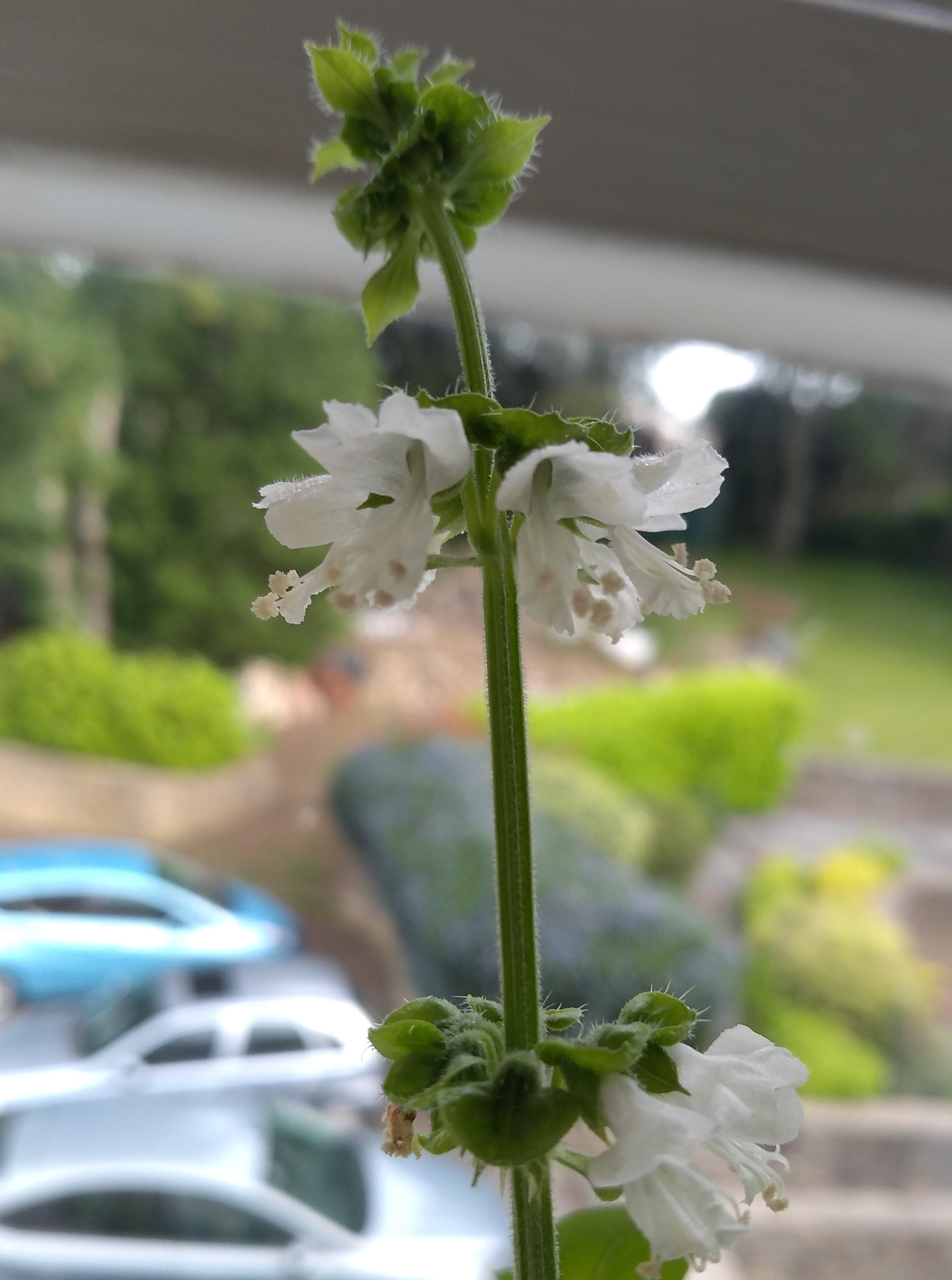
Basil (Ocimum basilicum, Sw: Basilika), a tender plant native to India and South East Asia. Possibly Africa, too; internet sources are a bit inconsistent about that. Anyway, the bulk of other Ocimum species are African. 

I have read that wild populations of Ocimum basilicum * live in dry scrubland, which seems so unlikely that I suppose it must be true. My own pot of basil, at any rate, requires daily watering. I was supposed to be eating it but got too interested in watching the plant develop. (If you grow basil for the leaves, you should pinch out the flower heads when they start to emerge.) Basil has been cultivated as a culinary and medicinal herb for thousands of years. 

[* Not to be confused with the species whose vernacular English name is Wild Basil (Clinopodium vulgare); a plant that's native to Europe and N. America as well as N. Africa and W. Asia.]


LII
Then in a silken scarf,—sweet with the dews
        Of precious flowers pluck'd in Araby,
And divine liquids come with odorous ooze
        Through the cold serpent-pipe refreshfully,—
She wrapp'd it up; and for its tomb did choose
        A garden-pot, wherein she laid it by,
And cover'd it with mould, and o'er it set
Sweet Basil, which her tears kept ever wet.

LIII
And she forgot the stars, the moon, and sun,
        And she forgot the blue above the trees,
And she forgot the dells where waters run,
        And she forgot the chilly autumn breeze;
She had no knowledge when the day was done,
        And the new morn she saw not: but in peace
Hung over her sweet Basil evermore,
And moisten'd it with tears unto the core.

LIV.
And so she ever fed it with thin tears,
        Whence thick, and green, and beautiful it grew,
So that it smelt more balmy than its peers
        Of Basil-tufts in Florence; for it drew
Nurture besides, and life, from human fears,
        From the fast mouldering head there shut from view:
So that the jewel, safely casketed,
Came forth, and in perfumed leafits spread.


(Isabella reburies the head of her murdered lover Lorenzo. From John Keats, Isabella, Or The Pot Of Basil).  


*

The unsettling tone of Keats' Boccaccio poem has been extensively discussed. I enjoyed looking through these essays:


Jack Stillinger, 'Keats and Romance', Studies in English Literature, 1500-1900
Vol. 8, No. 4, Nineteenth Century (Autumn, 1968), pp. 593-605. https://www.jstor.org/stable/449467

Louise Z. Smith, 'The Material Sublime: Keats and "Isabella"', Studies in Romanticism Vol. 13, No. 4 (Fall, 1974), pp. 299-311. https://www.jstor.org/stable/25599944

Susan Wolfson, 'Keats's "Isabella" and the "Digressions" of "Romance"', Criticism Vol. 27, No. 3 (summer, 1985), pp. 247-261. https://www.jstor.org/stable/23110370

Kurt Heinzelman, 'Self-Interest and the Politics of Composition in Keats's Isabella', ELH
Vol. 55, No. 1 (Spring, 1988), pp. 159-193. https://www.jstor.org/stable/2873115 

Diane Long Hoeveler, 'Decapitating Romance: Class, Fetish and Ideology in Keats's Isabella', Nineteenth-Century Literature Vol. 49, No. 3 (Dec., 1994), pp. 321-338. https://www.jstor.org/stable/2933819

Michael Lagory, 'Wormy Circumstance: Symbolism in Keats's "Isabella"', Studies in Romanticism
Vol. 34, No. 3, On Keats in 1995 (Fall, 1995), pp. 321-342. https://www.jstor.org/stable/25601124


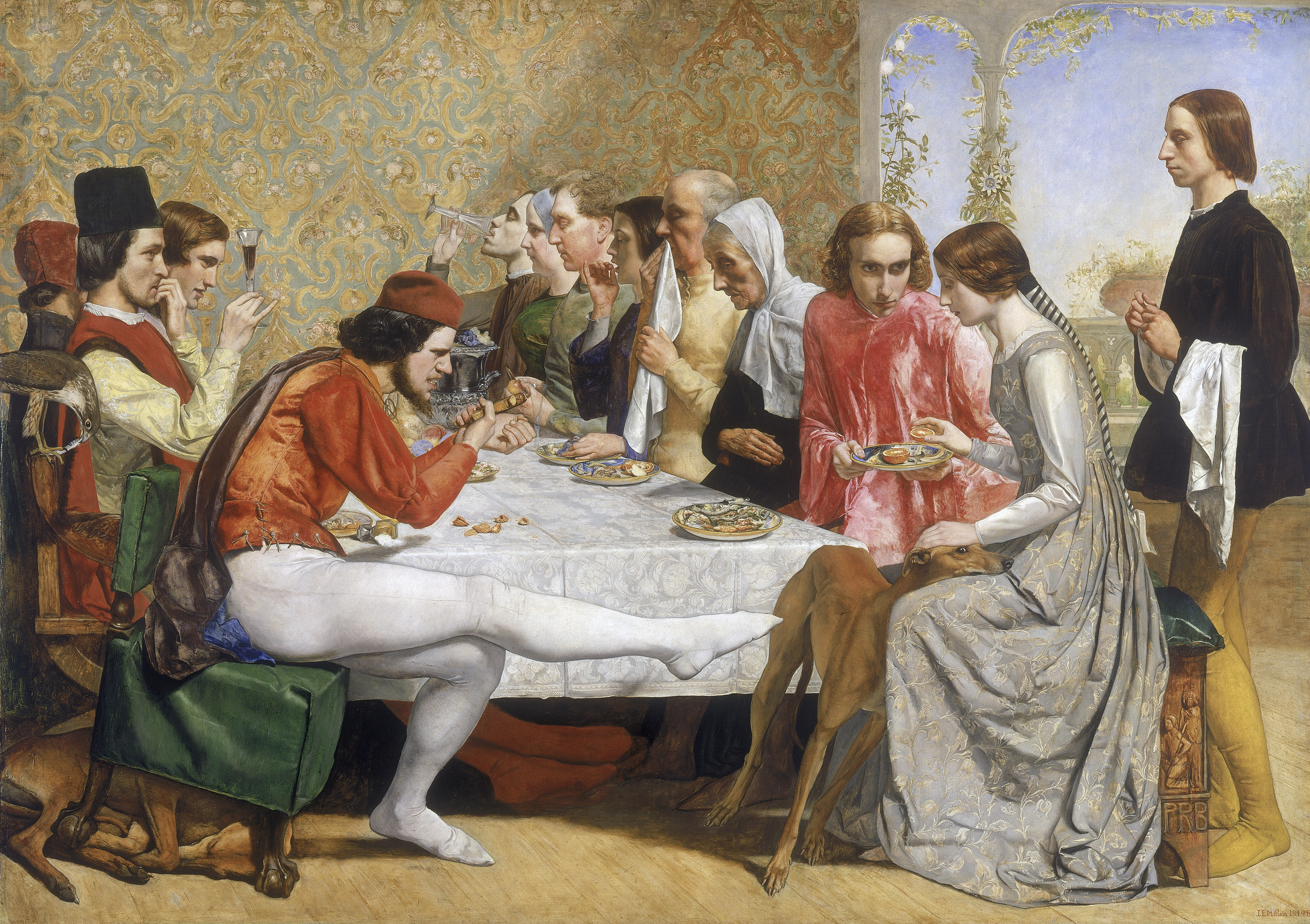
Isabella, 1849 painting by John Everett Millais


[Image source: Wikipedia . Millais was just nineteen when he painted it. Now in the Walker Art Gallery in Liverpool.]

These brethren having found by many signs
   What love Lorenzo for their sister had, ... (XXI)

Keats gave no further details. Millais imagined the discovery occurring at the dinner table. 

To the right, Lorenzo offers Isabella half a blood orange (unwittingly portending his own decapitation). Isabella's brothers (left) observe the intimacy of Lorenzo and Isabella. The brother at the front vents his rage by kicking the dog and pulverizing a nut in the nutcrackers. The other two seem to be meditating a more controlled but no less deadly approach. 

Lorenzo's face stands out as the only one not in profile. His gaze is haunting; even frightening, in a sickly devotional vampiric sort of way. I feel some sympathy with the brothers for wanting to shield their Isabella from it. 


Isabella and the Pot of Basil, sketch by Dante Gabriel Rossetti.


Isabella and the Pot of Basil, 1868 painting by William Holman Hunt

[Image source: Wikipedia .]


Isabella, or the Pot of Basil, 1877 painting by Joseph Severn


[Image source: https://www.meisterdrucke.uk/fine-art-prints/Joseph-Severn/302654/Isabella,-or-the-Pot-of-Basil,-1877-.html . Over half a century before he painted this, Joseph Severn had been Keats'  close friend; they probably met in 1816, and it was Severn who later accompanied the dying Keats to Italy.] 


Isabella and the Pot of Basil, 1897 painting by John White Alexander

[Image source: https://www.artsalonholland.nl/john-white-alexander/isabella-and-the-pot-of-basil . John White Alexander (1856 - 1915) was born in Pennsylvania. This painting is in the Boston Museum of Fine Arts.]

Isabella and the Pot of Basil, 1907 painting by John William Waterhouse


Isabella and the Pot of Basil, painting by George Henry Grenville Manton

[Image source: https://largesizepaintings.blogspot.com/2017/12/george-henry-grenville-manton-isabella.html . George Henry Grenville Manton (1855 - 1932) was a Hertfordshire painter. This painting is in Wycombe Museum. I haven't been able to find a date for it.]

*

Keats wrote Isabella between February and April 1818. The story came from Boccaccio's Decameron (Day 4, No 5). [Keats did not work directly from Boccaccio's Italian text, but from The Novels and Tales of the Renowned John Boccacio, 5th edn, 1684; an anonymous translation first published in 1620 and attributed to John Florio.]

Keats retold the story in ottava rima. This stanza form was actually Boccaccio's invention, but he did not use it in the Decameron, which was in prose. Keats was pretty likely to have come across it in, say, John Harington's 1591 translation of Ariosto's Orlando Furioso. But it had come back into prominence the previous year, when John Hookham Frere anonymously published his satiric poem, with the complicated title The Monks and the Giants: Prospectus and Specimen of an Intended National Work, supposedly by "William and Robert Whistlecraft, of Stow-Market, in Suffolk, Harness and Collar-Makers". The title is offputting, but the poetry is not.

I think that Poets (whether Whig or Tory)
   (Whether they go to meeting or to church)
Should study to promote their country's glory
   With patriotic, diligent research;
That children yet unborn may learn the story,
   With grammars, dictionaries, canes and birch:
It stands to reason -- this was Homer's plan,
And we must do -- like him -- the best we can.

(Proem, stanza VII)

Frere's poem, commonly named Whistlecraft by scholars, caught Byron's eye, and the result was Beppo, published on 28 February 1818. 


'Tis known, at least it should be, that throughout
   All countries of the Catholic persuasion,
Some weeks before Shrove Tuesday comes about,
   The people take their fill of recreation,
And buy repentance, ere they grow devout,
   However high their rank, or low their station,
With fiddling, feasting, drinking, dancing, masquing,
And other things which may be had for asking.

(Stanza I)


Keats would likely have read one of these recent poems if not both, and he has been criticized for failing to attain their urbanely cutting wit, especially when he steers close to raillery or satire ("Great wits in Spanish, Tuscan, and Malay" (XVII)). Then, or in the preceding stanza where Keats bludgeons away at "Why were they proud?" (XVI), the comparison with Byron is damaging. 

The criticism might be unfair. Keats was evidently not attempting to write in the vein of Frere or Byron; for example, his poem has few feminine rhymes, and those of the most commonplace kind. More likely he was aiming at something like a Chaucerian flexibility, receptive to many changes of mood, and I think he achieves it. And in such passages as the digging up of Lorenzo's body he got to a place beyond Chaucer, never mind Byron. 

But he could not be urbane: he was no middle-aged diplomat or glamorous young lord. He really loathed the brothers' capitalist exploitation and he wrote from the heart, as in the lovely letter to Fanny Brawne of which an appalled Matthew Arnold pronounced: "We have the tone, or rather the entire want of tone, the abandonment of all reticence and all dignity, of the merely sensuous man, of the man who 'is passion's slave.'" (I deeply love Arnold as a poet, but his literary criticism tends to infuriate me.)

I wondered if Keats, when he wrote Isabella, would have been familiar with the actual plant "Basile" that he found in the Boccaccio story (Decameron Day 4 No 5). 

Most likely, yes. Keats was apprenticed to an apothecary between 1810 and 1815, trained as a surgeon-apothecary at Guy's Hospital, and received his apothecary license in 1816. "Sweet Basil" was a plant that was grown in apothecaries' gardens: Nicholas Culpeper (The English Physician, 1652) had evidently grown it himself, noting that "It must be sowed late, and flowers in the heart of Summer, being a very tender plant". 

As for its properties, a cautious Culpeper found his authorities contradictory.  

This is the herb which all authors are together by the ears about, and rail at one another (like lawyers). Galen and Dioscorides hold it not fit to be taken inwardly; and Chrysippus rails at it with downright Billingsgate rhetoric; Pliny, and the Arabian physicians defend it.

For my own part, I presently found that speech true:

                           Non nostrum inter nos tantas componere lites.

And away to Dr. Reason went I, who told me it was an herb of Mars, and under the Scorpion, and perhaps therefore called Basilicon; and it is no marvel if it carry a kind of virulent quality with it. Being applied to the place bitten by venomous beasts, or stung by a wasp or hornet, it speedily draws the poison to it; Every like draws his like. Mizaldus affirms, that, being laid to rot in horse-dung, it will breed venomous beasts. Hilarius, a French physician, affirms upon his own knowledge, that an acquaintance of his, by common smelling to it, had a scorpion bred in his brain. Something is the matter; this herb and rue will not grow together, no, nor near one another: and we know rue is as great an enemy to poison as any that grows.

To conclude; It expels both birth and after-birth; and as it helps the deficiency of Venus in one kind, so it spoils all her actions in another. I dare write no more of it.


This account by Culpeper suggests that Sweet Basil had yet to find a place in the English kitchen. 

Keats is curiously insistent that Lorenzo and Isabella don't reveal their feelings to each other until May has passed into June (IV). In autumn Lorenzo is dead and Isabella "By gradual decay from beauty fell" (XXXII). Their love, like Sweet Basil itself, was a tender plant. 

NB "Sweet Basil" is the variety commonly grown and used in cooking, at least in Europe and N. America. There are about sixty other varieties. 


Fesleğen

şimdi orda buzlar eriyordur
yürümek istiyordur donmuş sular
sen bir odun atıyorsundur ateşe
bir odun daha

derken kış uyanıyor
bir akarsuda.

burda neler olduğunu kestirmek zor
elinde kitap olan bir adam
terkedilmiş bir bahçeye bakıyor
savaş haberleriyle uyanıyoruz

ihanete mi uğradık dağlarda
bir halk kendini tanımaya mı çalışıyor?

seni orda sanıyordum
güneşli pencerelerden mi çıkıp geldin
ellerin hâlâ fesleğen kokuyor?


Basil

there the ice must be melting now
the frozen waters wish to walk again
you must be putting a log on the fire
and perhaps another
just then in the river
winter awakens.

it is difficult to establish what has happened here
a man with a book in his hand
staring out at an abandoned orchard
we wake to news of war.
were we betrayed in the mountains
was a people struggling to know itself?

I thought you were there
have you come from the sun filled windows
your hands still smelling of basil?


(by Salih Bolat, b. 1956 in Adana. (Translator not specified.) Poem Source.)


A question the box of earth
still asks the kitchen,

...


as in a pot of,
where the lover's head

explodes into new 
ideas, as in

chop the loss finely,
add salt and stew

and halo the old charred
grandmother stove,

...

(from Sandra M. Gilbert's "Basil" (1997). Poem Source.)


An Ode to Basil

In Grecian myth
Good fortune springs
From all Sweet Basil brings.

It grows and thrives
In pot or ground
Wherever Sun is found.

Its perfumed leaves
Will bring you cheer
Throughout its growing Year.

And freshly picked
From fragrant bunch,
It makes a great Spaghetti lunch!


Labels: , , , , , , , ,

Powered by Blogger