Wednesday, December 27, 2023

Mr. Eusden

All Saints' Church, Spofforth (near Harrogate, North Yorkshire)

[Image source: Wikimedia Commons . This is where Laurence Eusden was baptised in 1688. His father was the rector.]


The Transformation of the THEBAN Matrons.

⁠The Theban Matrons their lov'd Queen pursu'd,
And tracing to the Rock, her Footsteps view'd.
Too certain of her Fate, they rend the Skies
With piteous Shrieks, and lamentable Cries.
All beat their Breast, and Juno all upbraid,
Who still remember'd a deluded Maid:
Who, still revengeful for one stol'n Embrace,
Thus wreak'd her Hate on the Cadmëan Race.
This Juno heard; and shall such Elfs, she cry'd,
Dispute my Justice, or my Pow'r deride?
You too shall feel my Wrath not idly spent;
A Goddess never for Insults was meant.
⁠She, who lov'd most, and who most lov'd had been,
Said, Not the Waves shall part me from my Queen.
She strove to plunge into the roaring Flood;
Fix'd to the Stone, a Stone her self she stood.
This, on her Breast would fain her Blows repeat,
Her stiffen'd Hands refus'd her Breast to beat.
That, stretch'd her Arms unto the Seas; in vain
Her Arms she laboured to unstretch again.
To tear her comely Locks another try'd,
Both comely Locks, and Fingers petrify'd.
Part thus; but Juno with a softer Mind
Part doom'd to mix among the feather'd Kind.
Transformed, the Name of Theban Birds they keep,
And skim the Surface of that fatal Deep.

(From Ovid's Metamorphoses Book IV, translation by Laurence Eusden.)

In the long darks I've sometimes been unable to read my paperback of A. D. Melville's wonderful 1986 translation of Ovid's Metamorphoses, instead resorting to the phone and the 1727 translation compiled by Samuel Garth.

https://en.m.wikisource.org/wiki/Metamorphoses_(tr._Garth,_Dryden,_et_al.)

It's a good fallback. It's the work of various authors including Dryden, Addison, Pope and others whose names are less remembered today. Book IV is mostly the work of Laurence Eusden (1688 - 1730).

Eusden had been appointed Poet Laureate in 1718, on more than usually flimsy grounds (his rivals said). His career and life were both, I imagine, shortened by the hard drinking mentioned by Pope in the Dunciad (this passage wasn't in the 1728 version, but was added after Eusden's death).

Whatever, Eusden's Metamorphoses translations must account for nearly all of his readers today. He's no Dryden, but he admired Dryden and learnt from him, and he must have given a lot of enjoyment to a lot of people. His work on Book IV includes such famous stories as Pyramus and Thisbe, the Sun in love, Perseus and Andromeda...; also some particularly unedifying examples of divine vengeance by Bacchus and Juno. (Eusden also translated Venus and Adonis in Book X.)

My quotation comes from the end of Juno's destruction of Ino and her family (apparently for no other reason than Ino being too happy; as you might say, "to wipe that smug grin off her face"). In lines 6-8 it's Eusden, not Ovid, who reasonably speculates that what really fuels Juno's cruelty is lingering hatred for Semele (Ino's sister). Eusden makes other additions too, e.g. the comment about Juno's "softer Mind" being revealed in the transformation of some of Ino's attendants to birds. (Despite these additions, his version of the passage is only three lines longer than Melville's.)

*

Here's a five-minute Eusden anthology, extracts from other poems that I've tracked down by following the links here:

https://en.m.wikisource.org/wiki/Author:Laurence_Eusden


Cease, cease, fair Nymph, to lavish precious Tears,
And discompose your Soul with airy Fears.
Look on Sicilia's glitt'ring Courts with Scorn;
A nobler Sceptre shall that Hand adorn.
Imperial Pomp shall sooth a gen'rous Pride;
The Bridegroom never will disgrace the Bride.
If you above Terrestrial Thrones aspire,
From Heav'n I spring, and Saturn was my Sire.
The Pow'r of Pluto stretches all around,
Uncircumscrib'd by Nature's utmost Bound:
Where Matter, mould'ring, dies, where Forms decay,
Thro' the vast trackless Void extends my Sway.
Mark not with mournful Eyes the fainting Light,
Nor tremble at this Interval of Night.
A fairer Scene shall open to your View,
An Earth more verdant, and a Heav'n more blue...

(Pluto to Proserpine, translated from Claudian's Rape. From Steele's Poetical Miscellanies.)

I find Pluto's speech terrifying, not just because he's gaslighting a rape victim but because his words are nevertheless so powerfully seductive. When someone starts to lull you into believing that his dead world is far superior to your living one, it's time to seriously wake up.

*

Some, by kind Fates, to Greatness force their way,
And without Dawnings show a glorious Day;
Others, by Fortune, and industrious Strife,
Arrive at Honours, in the Noon of Life.
Many by painful, slow degrees ascend,
And anxious, till the verge of Death, attend.
Great Dryden did not early Great appear,
Faintly distinguish'd in his thirti'th Year:
But Nature, when she would a Poet doom
To show ripe Wonders in his op'ning Bloom,
Lavishly gives from all her choicest Mines,
And the rich Oar with nicer Care refines.
Britannia grieves, such Blessings are but few,
A Cowley, C----------ve, and a M-----------gue.

(From "To the Right Honourable Charles, Lord Hallifax: Occasion'd by translating into Latin His Lordship's Poem on the Boyn; and Mr. Stepney's on the late King's Voyage into Holland". From Steele's Poetical Miscellanies. )

A persuasively humble reflection on early poetical success. Written when he was 21, nine years before he was appointed Poet Laureate.

*

Here Spices in Parterres promiscuous blow,
Not from Arabia's Fields more Odours flow.
The wanton Winds thro' Groves of Cassia play,
And steal the ripen'd Fragrancies away.
Here, with its Load the mild Amomum bends,
There, Cinnamon in rival Sweets contends.
A rich Perfume the ravish'd Senses fills,
While from the weeping Tree the Balm distills. 

(From a description of the court of Love, out of Claudian's Epithalamium of Honorius and Maria. From Steele's Poetical Miscellanies. )

I included this mainly to add a note on Amomum. Classical authors write of it as a spicy plant, but no-one knows which one they were referring to. Today it's the name of a genus of plants (notably including Black Cardamom). Oddly, it also turns up in the specific name Sison amomum (Stone Parsley); a plant with an odour that most people consider distinctly unpleasant.

*

On a Lady, Who is the most Beautiful and Witty when she is Angry.

LONG had I known the soft, enchanting Wiles,
Which Cupid practis'd in Aurelia's Smiles.
Till by degrees, like the fam'd Asian, taught,
Safely I drank the sweet, tho' poys'nous Draught.
Love vex'd to see his Favours vainly shown,
The peevish Urchin murder'd with a Frown.
What cautious Youth would thence have fear'd Surprize?
Can Beauty from Deformity arise?
In cloudless Nights do Light'nings harmless fly,
And only blast from a tempestuous Sky?
Mild Venus haunts the Shades and peaceful Groves,
Her Thoughts, her Looks, are tender as her Doves.
Smooth'd were the Waves, and ev'ry Triton sung,
When from old Ocean first the Goddess sprung.
Aurelia shuns the Calm, and loves the Storm,
Ruffles her Passions to improve her Form.
She by some Art, to th' artful Sex unknown,
Has all the Graces, when the rest have none.
Th' unsated Victor seeks new Triumphs still,
And whom her Eyes but wound, her Tongue must kill.
No hope of Safety, if inflam'd her Breast;
At once the Cha[r]mer Looks, and Talks, the best.
So Dryden sweetest sung, by Envy fir'd, 
Thirst of Revenge, if Phoebus fail'd, inspir'd. 
His Antony did Sydley's Muse o'ertake,
And Absalon was writ for Zimri's sake.
New Injuries new Laurels did presage,
And a Mac Fleckno was the Child of Rage.


One of three fine poems on the psychology of attraction, all in Steele's Poetical Miscellanies. In the second, Eusden is easily persuaded that Dryden is a bad poet, when he hears it from the lips of a good-looking woman. In the third, his preference for the older but wittier Delia leads on to a comparison with the deep feelings invoked by ancient monuments; it sounds tasteless, but it isn't. 

*

'Tis nobly done, thus to enrich the stage
And raise the thoughts of a degen'rate age;
To show how endless joys from freedom spring,
How life in bondage is a worthless thing.
The unborn greatness of your soul we view,
You tread the paths frequented by the few;
With so much strength you write, and so much ease,
Virtue and sense! how durst you hope to please?
Yet crowds, the sentiments of ev'ry line,
Impartial clap'd, and own'd the work divine.
Ev'n the sour critics, who malicious came,
Eager to censure, and resolv'd to blame,
Finding the hero regularly rise,
Great while he lives, but greater when he dies;
Sullen approv'd, too obstinate to melt,
And sicken'd with the pleasures which they felt.
Not so the fair, their passions secret kept,
Silent they heard, but as they heard, they wept ...


From a poem addressed to the author of Cato (Joseph Addison, 1713). Though Cato is rarely read or performed today, its political legacy, e.g. in the USA, is as vigorous as ever.  It inspired the Cato's Letters of Trenchard and Gordon, quoted e.g by the young Benjamin Franklin (as Silence Dogood) when he wrote "Without freedom of thought there can be no such thing as wisdom and no such thing as public liberty without freedom of speech".

(Quoted in Robert Bisset's Life of Lawrence Eusden, prefixing a 1793 edition of The Spectator; Eusden wrote some of the letters that appear within its pages.)


Labels: , , , ,

Wednesday, August 26, 2020

Cornelian cherry (Cornus mas)


Cornelian Cherry (Cornus mas). Frome, 25 August 2020.


Cornelian Cherry (Cornus mas)... Native to southern Europe (including most of France). Introduced to the British Isles back in the 16th century and sometimes found in the wild. 

Here, it's part of a fairly recent planting in a Frome public space (known as "the Dippy"), where it grows alongside the native shrub Dogwood (Cornus sanguinea). 

The two relatives look a bit similar, but are easily distinguished in spring (Cornelian Cherry has yellow flowers, Dogwood has white flowers) and at berry time (Cornelian Cherry has big red berries, Dogwood has small black ones). The leaves of Cornelian Cherry are a bit smaller than Dogwood, more narrowly pointed, and tougher in texture. Both leaf and leaf-stalk are usually strongly keeled (i.e. they won't lie flat). The twigs of Cornelian Cherry are rather robust compared with the slender shoots of Dogwood. (I've added a photo of Dogwood near the end of this post.)

The elongated "cherries" of Cornus mas are edible. Most of the berries shown in these photos would still taste a bit sour. When truly ripe they turn a deeper shade of red. They are then a fresh-tasting, rather delicious berry containing an elongate stone, attractively patterned with four veins. (If you pick an unripe one, take it indoors and it'll be ripe in a few hours.)

But do check you've got the right tree! Cornelian Cherry ripens around September time. You wouldn't want to be eating e.g. the winter-time berries of Japanese Laurel (Aucuba japonica), which are extremely bitter and also somewhat toxic. 

In southern Europe Cornelian Cherry fruit is much used for jams, in liqueurs, etc. 

Older sources say that the fruit rarely ripens in the UK. But the warmer climate is changing that, and I've seen plenty of fruit in each of the two summers since I first noticed these trees. 


Cornelian Cherry (Cornus mas). Frome, 25 August 2020.


Cornus mas is the cornel (cornum) of classical poetry. Horace boasts of the cornels at his Sabine farm. 

It supplied food:

On wildings and on strawberries they fed;
Cornels and bramble-berries gave the rest . . .

(Ovid's description of the Golden Age, see Metamorphoses I.105)

Autumnal cornels next in order serv'd
In lees of wine well pickled, and preserv'd . . .

(Philemon and Baucis, see Metamorphoses 8.668)

And it also appears as the traditional wood used for spear-shafts:

whether with strong arm you hurl the pliant shaft, your gallant arm draws my regard upon itself, or whether you grasp the broad-headed cornel hunting-spear. 

(Phaedra to Hippolytus, see Heroides 4.83)

[The wood of Cornus mas is exceptionally dense and hard, useful for the shafts of tools and weapons. It sinks in water.]

Concerning the battle of the Granicus (334 BCE), Arrian notes that Alexander's cavalry had the advantage of using cornel-wood lances compared with the light javelins of the Persians.


The names Cornelius and Cornelia derive from the senior Roman patrician family, the Cornelii. I'd like to think they took their family name from this tree, just as, according to Pliny, the Fabii took theirs from the bean faba. But I've not found anyone else suggesting this. 


Fallen "cherries" of Cornelian Cherry (Cornus mas). Frome, 25 August 2020.


Fallen "cherries" and stones of Cornelian Cherry (Cornus mas). Frome, 25 August 2020.


Cornelian Cherry (Cornus mas). Frome, 25 August 2020.


Cornelian Cherry (Cornus mas). Frome, 25 August 2020.


Cornelian Cherry (Cornus mas), a ripe "cherry" and the attractive stone. Frome, 11 October 2021.


Winter buds of Cornelian Cherry (Cornus mas). Frome, 18 January 2021.


Cornelian Cherry in winter has a distinctively bobbly appearance, with round winter buds.


Winter buds of Cornelian Cherry (Cornus mas). Frome, 18 January 2021.


Bark of Cornelian Cherry (Cornus mas). Frome, 31 January 2022.


Opening buds of Cornelian Cherry (Cornus mas). Frome, 31 January 2022.


Opening buds of Cornelian Cherry (Cornus mas). Frome, 31 January 2022.


Opening buds of Cornelian Cherry (Cornus mas). Frome, 31 January 2022.


Blossoms of Cornelian Cherry (Cornus mas). Frome, 25 March 2021.


Blossoms of Cornelian Cherry (Cornus mas). Frome, 25 March 2021.


Emerging leaves of Cornelian Cherry (Cornus mas). Frome, 25 March 2021.


"Cherries" starting to turn red on Cornelian Cherry (Cornus mas). Frome, 7 August 2022.


Dogwood (Cornus sanguinea). Swindon, 27 August 2020.


Labels: , , ,

Wednesday, May 06, 2020

upon May

Stachys sylvatica. Swindon, 4th May 2020.

Together we will find a way
In the first days of May . . .

The 4th of May. These celebrated early days of May, invoking so many snatches of lyric but not where they came from.

Accelerating climate change means it feels more like late May. The cherry blossom is long gone, the grasslands swell. But I'm still scratching around in the deepening shade of the woods, where there are secrets to be found. The woods of West Swindon are rather mysterious places.

Here's a shapely group of fresh Hedge Woundwort (Stachys sylvatica, Sw: Stinksyska).

Stachys sylvatica. Swindon, 4th May 2020.

Valborgsmässoafton, Walpurgisnacht, is the evening of 30th April, and then it's May Day, the first of a clutch of family birthdays: my nephew Nick on 1st May, and my sister Miranda on 3rd May.

Chaucer seems to have attached some importance to 3rd May, too. He selects it as the date  that Palamon broke out of his prison (The Knight's Tale), the date of the action of The Nun's Priest's Tale), and the date Pandare was afflicted by love-sickness (Troilus and Criseyde).

John P. McCall (MLN vol 76, No. 3 (Mar 1961), pp. 201-205) suggested that Chaucer thought of it as a day when lovers feel their desires with especial keenness, and that Chaucer inferred this from Ovid's Fasti, where 3rd May is assigned to celebrations of the goddess Flora.

But May, of course, was when most stories happened.

Ac on a May morwenynge on Malverne hilles     (William Langland, Piers Plowman, Prologue, line 5)

But love, whilst that thou mayst be loved again --
Now, whilst thy May hath filled thy lap with flowers,
Now, whilst thy beauty bears without a stain --
Now use the summer smiles, ere winter lowers.   (The beginning of Samuel Daniel's Delia Sonnet 32)


THESEUS
No doubt they rose up early to observe
The rite of May, and hearing our intent,
Came here in grace of our solemnity.       (A Midsummer Night's Dream, IV.1.137-139)

[Shakespeare momentarily forgetting the date implications of his title?]


Silene dioica. Swindon, 4th May 2020.

In dappled sunlight on a woodland edge, Red Campion (Silene dioica, Sw: Rödblära). 

Common throughout GB. Its distribution in Sweden is rather peculiar; it's common through most of Sweden, including most of Norrland, but less so in the east of the country from Stockholm southwards (the region that is typically richest in plant species), and rare in Gotland and Öland. I can only suppose that some other plant or plants are so favoured by Baltic conditions that they contest its niche. 

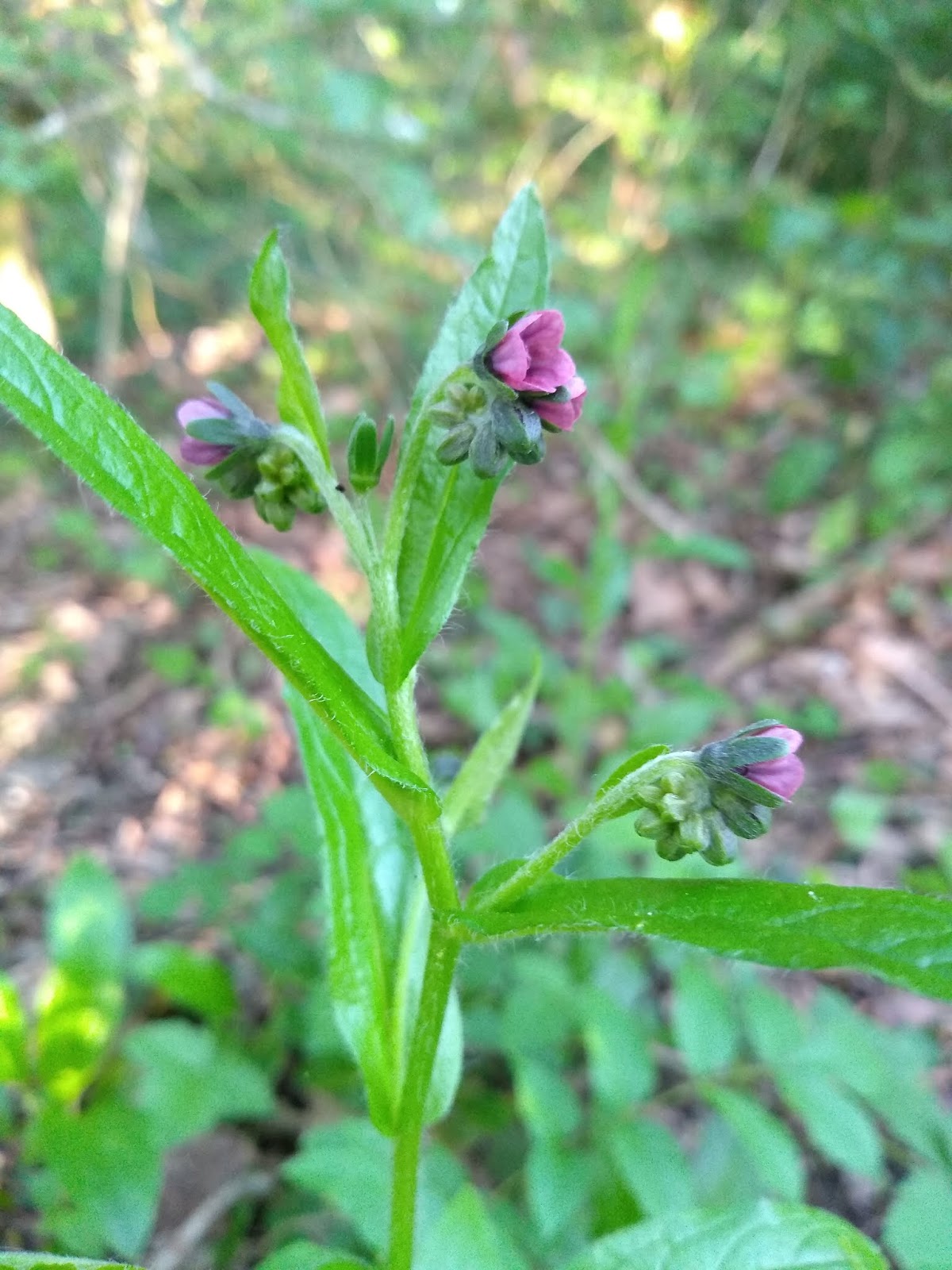
Cynoglossum germanicum. Swindon, 4th May 2020.

Green Hound's-tongue (Cynoglossum germanicum). Rare in the UK, absent from Sweden.

The photo below gives a better idea of the plant's size at this time of year.

Cynoglossum germanicum. Swindon, 4th May 2020.


Aquilegia vulgaris, Anemone nemorosa, Stachys officinalis. Swindon, 4th May 2020.

A classy grouping, on a woodland edge, of Columbine (Aquilegia vulgaris, Sw: Akleja), Wood Anemone (Anemone nemorosa, Sw: Vitsippa) and Betony (Stachys officinalis formerly called Betonica officinalis, Sw: Humlesuga).


Aquilegia vulgaris. Swindon, 4th May 2020.

Stachys officinalis. Swindon, 4th May 2020.

Shady conditions usually mean that plants take longer to flower, but since shade also means shelter, it sometimes triggers an individual plant to flower exceptionally early, like the Betony above.

Betony is common through most of the British Isles, except Ireland and northern Scotland. In Sweden it's an extreme rarity, known only in a handful of southern sites.


Labels: , , , , ,

Sunday, April 08, 2018

towards Collatia

Castello di Lunghezza

[Image source: https://www.matrimonio.com/castelli-matrimoni/castello-di-lunghezza--e34941/fotos/13 . You can have your wedding reception there!]

The medieval Castello di Lunghezza, on a hill just south of the river Aniene (Latin Anio), is generally thought to occupy the site of the ancient town of Collatia, though no traces have been found.


Shakespeare called it Collatium.


FROM the besieged Ardea all in post,
Borne by the trustless wings of false desire,
Lust-breathed Tarquin leaves the Roman host,
And to Collatium bears the lightless fire
Which, in pale embers hid, lurks to aspire
And girdle with embracing flames the waist
Of Collatine's fair love, Lucrece the chaste.


(Shakespeare, The Rape of Lucrece Stanza 1)


Shakespeare's sources were Livy Ab Urbe Condita Bk I (which he may have encountered at school) and Ovid's Fasti Book II (February). His poem (written c. 1593) pre-dated the first complete English translation of Livy (by Philemon Holland in 1600). Thomas Heywood's tragedy The Rape of Lucrece dates from 1608.

No poet of Shakespeare's time was interested in pace. Chaucer had been such a master of it, but now the object of narrative verse was quite changed. Shakespeare's poem, after that thrill of an opening stanza, switches almost immediately to the static elaborate musical figuration of Tarquin's thoughts (pre-rape) and Lucrece's thoughts (post-rape).


*

The story can be given in Shakespeare's own words. This is The Argument to his poem. It always gives me a funny feeling when I read it.  I find myself thinking that here, almost uniquely, is Shakespeare writing merely  as himself,  not in the role of another character, nor as part of an elaborate social ritual (as, very obviously, in the preceding dedication to Henry Wriothesley). I might well be mistaken. Maybe these long Latinate sentences with their suspended clauses are just another mask: Shakespeare in the role of historian. Maybe the switching between past tense and historic present tense isn't unreflecting and spontaneous, but is part of the assumed garb of a storyteller. Maybe "writing as oneself" did not even exist in those days. Whatever, it's intriguing to see Shakespeare so far off his usual patch.


*


THE ARGUMENT


Lucius Tarquinius, for his excessive pride surnamed Superbus, after he had caused his own father-in-law Servius Tullius to be cruelly murdered, and, contrary to the Roman laws and customs, not requiring or staying for the people's suffrages, had possessed himself of the kingdom, went, accompanied with his sons and other noblemen of Rome, to besiege Ardea. During which siege the principal men of the army meeting one evening at the tent of Sextus Tarquinius, the king's son, in their discourses after supper every one commended the virtues of his own wife: among whom Collatinus extolled the incomparable chastity of his wife Lucretia. In that pleasant humour they posted to Rome; and intending, by their secret and sudden arrival, to make trial of that which every one had before avouched, only Collatinus finds his wife, though it were late in the night, spinning amongst her maids: the other ladies were all found dancing and revelling, or in several disports. Whereupon the noblemen yielded Collatinus the victory, and his wife the fame. At that time Sextus Tarquinius being inflamed with Lucrece' beauty, yet smothering his passions for the present, departed with the rest back to the camp; from whence he shortly after privily withdrew himself, and was, according to his estate, royally entertained and lodged by Lucrece at Collatium. The same night he treacherously stealeth into her chamber, violently ravished her, and early in the morning speedeth away. Lucrece, in this lamentable plight, hastily dispatcheth messengers, one to Rome for her father, another to the camp for Collatine. They came, the one accompanied with Junius Brutus, the other with Publius Valerius; and finding Lucrece attired in mourning habit, demanded the cause of her sorrow. She, first taking an oath of them for her revenge, revealed the actor, and whole manner of his dealing, and withal suddenly stabbed herself. Which done, with one consent they all vowed to root out the whole hated family of the Tarquins; and bearing the dead body to Rome, Brutus acquainted the people with the doer and manner of the vile deed, with a bitter invective against the tyranny of the king: wherewith the people were so moved, that with one consent and a general acclamation the Tarquins were all exiled, and the state government changed from kings to consuls.


(Shakespeare, The Rape of Lucrece)


*


"...Give me your solemn promise that the adulterer shall be punished -- he is Sextus Tarquinius. He it is who last night came as my enemy disguised as my guest, and took his pleasure of me. That pleasure shall be my death -- and his too, if you are men."

The promise was given. One after another they tried to comfort her. They told her she was helpless, and therefore innocent; that he alone was guilty. It was the mind, they said, that sinned, not the body: without intention there could never be guilt.

"What is due to him," Lucretia said, "is for you to decide. As for me I am innocent of fault, but I will take my punishment. Never shall Lucretia provide a precedent for unchaste women to escape what they deserve." With these words she drew a knife from under her robe, drove it into her heart, and fell forward, dead.

Her father and husband were overwhelmed with grief. While they stood weeping helplessly, Brutus drew the bloody knife from Lucretia's body, and holding it before him cried: "By this girl's blood -- none more chaste till a tyrant wronged her -- and by the gods, I swear that with sword and fire, and whatever else can lend strength to my arm, I will pursue Lucius Tarquinius the Proud, his wicked wife, and all his children, and never again will I let them or any other man be King in Rome."

(Livy, translated by Aubrey de Selincourt)


*


She called her aged father and her loyal husband
    From the camp, and both came without delay.
Seeing her condition, they asked why she mourned,
    Whose rites she prepared, what ill had befallen her?
She was silent for a long time, and hid her face in her robe
    Out of shame: her tears flowed in a running stream.
Her father here, her husband there comforted her tears
    And begged her to tell, wept, and trembled in blind fear.
Three times she tried to speak, three times desisted,
    And a fourth time, gaining courage, still couldn’t raise her eyes.
She said: ‘Must I owe this to a Tarquin too? Must I speak,
    Speak, poor wretch, my shame from my own mouth?’
What she could, she told. The end she suppressed:
    She wept, and a blush spread over a wife’s cheeks.
Her husband and her father forgave her being forced:
    She said: ‘I deny myself the forgiveness that you grant.’
Then she stabbed herself with a blade she had hidden,
    And, all bloodied, fell at her father’s feet.
Even then she took care in dying so that she fell
    With decency, that was her care even in falling.
See, the husband and father throw themselves on her body,
    Regardless of appearances, grieve for their mutual loss.
Brutus approached, and at last, with spirit, belied his name,
    Snatching the weapon from the dying body,
Holding the blade dripping with noble blood,
     Fearlessly he uttered these menacing words:
‘I swear by this chaste blood, so courageous,
    And by your spirit that will be a divinity to me,
I will be revenged on Tarquin the Proud and his lost brood.
    I have concealed my virtue for too long.’
At these words, lying there, she moved her sightless eyes,
    And seemed to witness the speech by a stirring of her hair.
They carried her to her funeral, a woman with a man’s courage,
    And tears and indignation followed after her.


(Ovid Fasti II, about February 24, day of  the Regifugium.)


[Translation by A.S. Kline. The whole of this translation is available online:  https://www.poetryintranslation.com/PITBR/Latin/Fastihome.php . I had never read any of the Fasti before:  it turns out to be a rather wonderful poem. ]


*


The words of Lucretia are still incandescent. But this is a myth cultivated by men. In the story the men-folk themselves are specifically exculpated from having approved or wished for Lucretia's self-sacrifice. Yet the myth itself does exactly that. It promotes Lucretia as a woman hero (exemplifying the key womanly virtue,i.e. chastitiy). And it sees her as an inspiring and unsparing exemplum of zero tolerance for (female) unchastity.


 *


Shakespeare, to his credit I think, can't quite bear to stick with this myth. His Brutus points out that Lucrece's suicide, far from being a noble exemplum, is after all a dreadful mistake.


'Thou wronged lord of Rome,' quoth be, 'arise:
Let my unsounded self, supposed a fool,
Now set thy long-experienced wit to school.
'Why, Collatine, is woe the cure for woe?
Do wounds help wounds, or grief help grievous deeds?
Is it revenge to give thyself a blow
For his foul act by whom thy fair wife bleeds?
Such childish humour from weak minds proceeds:
Thy wretched wife mistook the matter so,
To slay herself, that should have slain her foe.

But no, that isn't the total judgment of the poem: in fact Shakespeare was not in the business of judging, but of imagining how the Lucrece he had read about must have felt.


'In vain,' quoth she, 'I live, and seek in vain
Some happy mean to end a hapless life.
I fear'd by Tarquin's falchion to be slain,
Yet for the self-same purpose seek a knife:
But when I fear'd I was a loyal wife:
So am I now: O no, that cannot be;
Of that true type hath Tarquin rifled me.

----

'Few words,' quoth she, 'Shall fit the trespass best,
Where no excuse can give the fault amending:

-----

'O, teach me how to make mine own excuse!
Or at the least this refuge let me find;
Though my gross blood be stain'd with this abuse,
Immaculate and spotless is my mind;
That was not forced; that never was inclined
To accessary yieldings, but still pure
Doth in her poison'd closet yet endure.'

----

But she, that yet her sad task hath not said,
The protestation stops. 'O, speak, ' quoth she,
'How may this forced stain be wiped from me?

'What is the quality of mine offence,
Being constrain'd with dreadful circumstance?
May my pure mind with the foul act dispense,
My low-declined honour to advance?
May any terms acquit me from this chance?
The poison'd fountain clears itself again;
And why not I from this compelled stain?'

With this, they all at once began to say,
Her body's stain her mind untainted clears;
While with a joyless smile she turns away
The face, that map which deep impression bears
Of hard misfortune, carved in it with tears.
'No, no,' quoth she, 'no dame, hereafter living,
By my excuse shall claim excuse's giving.'


So the poem turns over and over Lucrece's feeling of violation and shame, a feeling of something as irrevocable as Lady Macbeth's guilt, although Lucrece is not guilty.

Brilliant as this psychological poetry is, the object of violation is still seen, predominantly, as chastity, the role of a wife. So reading it is a bit too comfortable. When all's said it's still a man's poem, its rape is distanced in time, distanced too in the high social status of criminal and victim. Stating the obvious, it's an idealized picture, and after a time that makes me feel a bit uneasy, so this post ends with a corrective of sorts.    


Labels: , ,

Powered by Blogger