Wednesday, May 06, 2020

upon May

Stachys sylvatica. Swindon, 4th May 2020.

Together we will find a way
In the first days of May . . .

The 4th of May. These celebrated early days of May, invoking so many snatches of lyric but not where they came from.

Accelerating climate change means it feels more like late May. The cherry blossom is long gone, the grasslands swell. But I'm still scratching around in the deepening shade of the woods, where there are secrets to be found. The woods of West Swindon are rather mysterious places.

Here's a shapely group of fresh Hedge Woundwort (Stachys sylvatica, Sw: Stinksyska).

Stachys sylvatica. Swindon, 4th May 2020.

Valborgsmässoafton, Walpurgisnacht, is the evening of 30th April, and then it's May Day, the first of a clutch of family birthdays: my nephew Nick on 1st May, and my sister Miranda on 3rd May.

Chaucer seems to have attached some importance to 3rd May, too. He selects it as the date  that Palamon broke out of his prison (The Knight's Tale), the date of the action of The Nun's Priest's Tale), and the date Pandare was afflicted by love-sickness (Troilus and Criseyde).

John P. McCall (MLN vol 76, No. 3 (Mar 1961), pp. 201-205) suggested that Chaucer thought of it as a day when lovers feel their desires with especial keenness, and that Chaucer inferred this from Ovid's Fasti, where 3rd May is assigned to celebrations of the goddess Flora.

But May, of course, was when most stories happened.

Ac on a May morwenynge on Malverne hilles     (William Langland, Piers Plowman, Prologue, line 5)

But love, whilst that thou mayst be loved again --
Now, whilst thy May hath filled thy lap with flowers,
Now, whilst thy beauty bears without a stain --
Now use the summer smiles, ere winter lowers.   (The beginning of Samuel Daniel's Delia Sonnet 32)


THESEUS
No doubt they rose up early to observe
The rite of May, and hearing our intent,
Came here in grace of our solemnity.       (A Midsummer Night's Dream, IV.1.137-139)

[Shakespeare momentarily forgetting the date implications of his title?]


Silene dioica. Swindon, 4th May 2020.

In dappled sunlight on a woodland edge, Red Campion (Silene dioica, Sw: Rödblära). 

Common throughout GB. Its distribution in Sweden is rather peculiar; it's common through most of Sweden, including most of Norrland, but less so in the east of the country from Stockholm southwards (the region that is typically richest in plant species), and rare in Gotland and Öland. I can only suppose that some other plant or plants are so favoured by Baltic conditions that they contest its niche. 
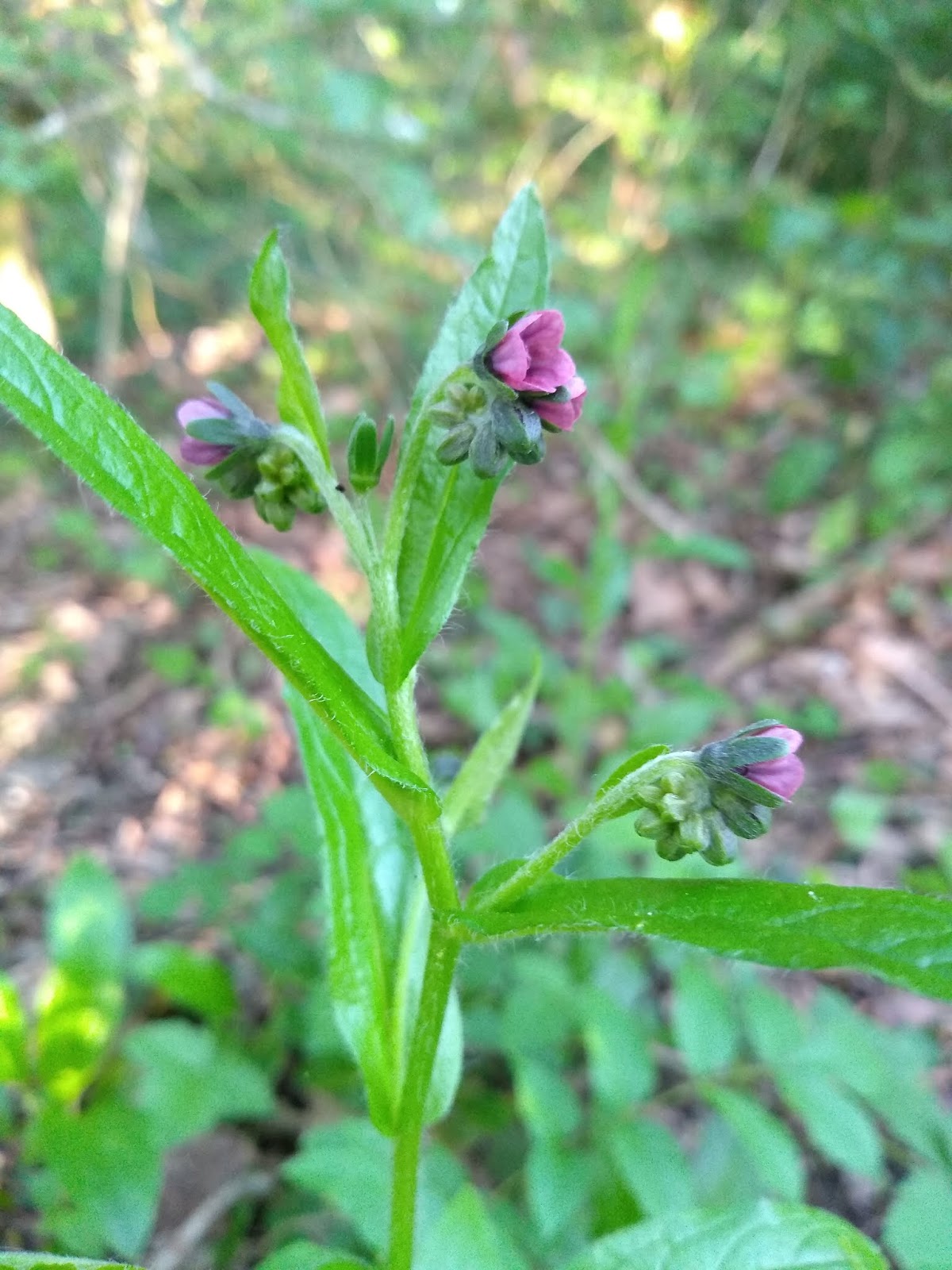
Cynoglossum germanicum. Swindon, 4th May 2020.

Green Hound's-tongue (Cynoglossum germanicum). Rare in the UK, absent from Sweden.

The photo below gives a better idea of the plant's size at this time of year.

Cynoglossum germanicum. Swindon, 4th May 2020.


Aquilegia vulgaris, Anemone nemorosa, Stachys officinalis. Swindon, 4th May 2020.

A classy grouping, on a woodland edge, of Columbine (Aquilegia vulgaris, Sw: Akleja), Wood Anemone (Anemone nemorosa, Sw: Vitsippa) and Betony (Stachys officinalis formerly called Betonica officinalis, Sw: Humlesuga).


Aquilegia vulgaris. Swindon, 4th May 2020.

Stachys officinalis. Swindon, 4th May 2020.

Shady conditions usually mean that plants take longer to flower, but since shade also means shelter, it sometimes triggers an individual plant to flower exceptionally early, like the Betony above.

Betony is common through most of the British Isles, except Ireland and northern Scotland. In Sweden it's an extreme rarity, known only in a handful of southern sites.


Labels: , , , , ,

Thursday, May 05, 2016

What did you do in the eighties?

The pilgrim, from an MS of the C-text  of Piers Plowman

[Image source: Bodleian Library . This is MS Douce 104, parchment, dated 1427. It refers to the famous passage in C VIII 160ff.  (B V 515-536 in the online text).]


I need less stuff. So the time has finally come, nearly thirty years after finishing my PhD thesis, to get rid of a whole ring-binder of photocopied texts from University libraries. (I remember how I pondered, as I greedily monopolized a secluded copier, whether it was legal to photocopy a whole book.)

Let's take a last farewell.

1. First up, the whole of the Z text of Piers Plowman. The ms had been long known, and dismissed as a corrupt version. The editors Rigg and Brewer presented the text anew, along with highly persuasive arguments that this was in fact the earliest version of the poem that would be Langland's life-work.Here are two lines from Z:

Myllares and mynstrales and masones somme,
Of all libbynge labores lopen forth there...

So little have I kept up with Piers Plowman scholarship that I was astonished to read (in Wikipedia) that the Z hypothesis has not won general acceptance, and even more so to hear of Lawrence Warner's claim that the B text in the form we know it incorporates large elements of C.

2. '"Quod" and "seide" in Piers Plowman' . Neat typing. My interesting article, published in Neuphilologische Mitteilungen.

3. George Kane's edition of the A text. This and the Kane-Donaldson B text were the scholarly editions of my time. Doubts about their method and their numerous conjectural emendations were there from the first, and slowly gathered force. But the completeness of their apparatus should be credited with making the articulation of demurring viewpoints possible.

4. Substantial extracts from John M Bowers' book, The Crisis of Will in Piers Plowman. The page I'm looking at speculates that Langland had connections with Worcester cathedral school.

5. Chapter Two of A.V.C Schmidt's The Clerkly Maker: Langland's Poetic Art. I must have finished my thesis by the time I photocopied this; I was still under the momentary illusion that I would carry on ploughing my half-acre, but of course the call of a wider world - of literature, that is! -  was too strong. I'm not sure I ever got round to reading what I'd photocopied. (I spot, in passing, Schmidt's comments on Langland's use of identical rhyme, and him comparing it with another poet with Malvern connections, Geoffrey Hill.) I had been a great admirer of Schmidt's edition of the B Text, which is I believe the basis of the online text of Piers Plowman. (Schmidt's text, a late and uncharacteristic triumph for the moribund Everyman series, became in effect the canonical text of the internet age by presciently eliminating the obsolete characters (thorn and yogh).)

6.  John Norton-Smith, William Langland. This, on the other hand, was a book I referred to quite a lot, critical yet appreciative, a challenge to weak praisers. His approach from a wide literary learning (as opposed to medievalism) - in the first three pages we grapple with Coleridge, Chaucer, and Browning - appealed to me. He was, as I learn from reading an obituary that I stapled to the back of one of the photocopies, an expat American, a friend of Philip Larkin, a good jazz musician who was once asked to join Louis Armstrong's band, a student of C.S. Lewis, a committed Oxonian (he despised "Cambridge") whose career lay mostly outside Oxford, an "old-fashioned" scholar (i.e. no truck with theory), a drinker and anecdotalist, and he could be crushing, outspoken and tactless, getting into hot water with progressive student politics at Dundee. A typical conservative don of his time perhaps. But I admired this book greatly. (I was such a shy student that in those days I had no real awareness of the political dimensions of what I was reading.)

There follow various substantial hand-written notes on other medieval studies and texts. There isn't the least chance that I, or anyone else, will ever look at them, and if anybody did I doubt if there'd be much to reward them. A lot of the time I was only amusing myself, and reading widely but without direction; not much of this got into the thesis. Nevertheless I apparently am not quite ready to bin them. Not this evening, anyway. There is a sort of fear: as if these never-consulted notes on the Roman de la Rose, Deguileville, saint's lives, medieval sermons and the like, carted from one gaff to another, might somehow constitute who I am. I might wake up the next day and find I don't exist!


Labels:

Powered by Blogger