Prelude #21

The 21st of my preludes for guitar. This one's in E minor.
All the Preludes so far:
Labels: Music to listen to
Permalink posted by Michael Peverett @ 6:50 pm
0 comments


"Not even not wrong" Email to: michaelpeverett@live.co.uk
The 21st of my preludes for guitar. This one's in E minor.
All the Preludes so far:
Labels: Music to listen to
Permalink posted by Michael Peverett @ 6:50 pm
0 comments

My twentieth prelude, in A flat. Four more to go!
Listen to all the preludes so far:
Labels: Music to listen to
Permalink posted by Michael Peverett @ 10:11 pm
0 comments

As a result of busking I've built up a ton of songs that I've never recorded, so I quickly did a tranche without fussing about perfection, and it makes a kind of album.
You can play the whole thing here:
https://whyp.it/collections/5555/september-2025
Individual tracks, if you'd rather pick and choose:
1. The Weight
Composer: Robbie Robertson, 1968. My key: D. Capo: 5th fret.
2. The Mayor of Simpleton
Composer: Andy Partridge, 1989. My key: C. Capo: 5th fret.
3. La Mer
Composer: Charles Trenet, 1943. My key: Eb. Capo: 3rd fret.
4. Little Deuce Coupe
Composers: Brian Wilson and Roger Christian, 1963. My key: C. Capo: 5th fret.
5. You're Still On My Mind
Composer: George Jones, 1962. My key: G. Capo: 3rd fret.
6. Sha La La (Make Me Happy)
Composer: Al Green, 1974. My key: C. Capo: None.
7. Joanne
Composer: Michael Nesmith, 1970. My key: G. Capo: None.
8. Streets of Forbes
Composer: Anonymous (John McGuire, 1865?). My key: Cm. Capo: 3rd fret.
9. No Man's Land
Composer: Eric Bogle, 1976. My key: F. Capo: 3rd fret.
10. A Matter of Time
Composers: David Hidalgo and Louie Pérez, 1984. My key: Eb. Capo: 3rd fret.
11. Sweet Sixteen
Composer: James Thornton, 1898. My key: Bb. Capo: 3rd fret.
12. Homeward Bound
Composer: Paul Simon, 1965. My key: Ab. Capo: 1st fret.
A bit more about the songs here:
https://michaelpeverett.blogspot.com/2024/04/what-shall-i-play-next.html

Labels: Music to listen to
Permalink posted by Michael Peverett @ 6:22 pm
0 comments
Prelude No 18, in A minor. It was very difficult to avoid some of the familiar turns of this very familiar guitar key -- too difficult for me, anyway. I at least contrived to avoid the usual dominant of E7 (using Bb7 instead), and I enjoyed using the bottom E fifth in the melody line. I finished this one during a morning in the van in the Largo do Espírito Santo, Idanha-a-Velha.
All the Preludes so far:
Labels: Music to listen to
Permalink posted by Michael Peverett @ 9:18 am
0 comments


Labels: Music to listen to
Permalink posted by Michael Peverett @ 1:16 pm
0 comments

Sandy Denny's remarkable song, said to be only the second one she ever wrote.
Like Lee Harwood's "Question of Geography", a defining 1960s document, portrait of a new society.
Time in the song comes before us in two aspects. First the passing of time, endless, flowing, mysterious: something we don't need to count or fear or try to dance to the tune of. The landscape of the song is austere and wintry, but there's a luxuriance in that copious time. Second is the instinct of knowing that "it's time", as manifested by the birds leaving the shore, and as also manifested, in the crucial third verse, by Sandy and her lover knowing when it's time for their love to end.
The song rejects the promptings of society ("you'd better get a job, pull yourself together"), of parents ("when are you getting married"), friends ("you're so good together", or "s/he's bad for you"), the church, politicians, the media, everyone. It even rejects nature, or rather the surface nature of weather and seasonal changes, in favour of a conviction that springs from a deeper nature: When the time comes, I'll know...
Opinions differ on whether it's one of the most joyous songs ever written, or one of the most desperately sad. Probably both. Its portrait of a new way of living, a way of youth, is eternally inspiring but also, if you think how it all went wrong then, a lament and a judgment. (Sandy's alcohol-related death in 1978 colours how we hear it, too.)
No-one could sing it better than she did, and there'll never be a better version than the one on Fairport Convention's Unhalfbricking (1969), with Richard Thompson's guitar weaving through the song's unhurried spaciousness.
Nevertheless, it's a song lots of us want to try for ourselves. Here's my sketchy first attempt, still reading the lyrics off my phone and before I even had the melody quite right, but I thought it came out OK.
[I'm using Whyp to host this, because I've run out of space on Soundcloud... bit of an experiment....]
Labels: Music to listen to, Sandy Denny
Permalink posted by Michael Peverett @ 11:22 am
2 comments

While staying at Kyli's for a couple of days, I managed to record a singalong album of well known Swedish songs. All except one are in the 1944 edition of Sjung Svenska Folk! They're a mixture, both seasonally and functionally: a carol, a lullaby, a sentimental love song, a folk song, dance songs, children's songs, walking songs... Most Swedes would still recognize most of these tunes.
Hopefully we'll have some fun with this at Christmas and beyond. Anyway you can listen to my handiwork here....
1. I sommarens soliga dagar (In the sunny days of summer). Words: G. E. Johansson, to an old marching tune. (Sjung Svenska Folk no. 104.)
2. Videvisan (Willow song). Words: Z. Topelius. Music: Alice Tegnér 1864 - 1943. (Sjung Svenska Folk no. 52.)
3. Fjäriln vingad syns på Haga (Wingèd butterfly in Haga). Words and music: C. M. Bellman 1740 - 1795. (Sjung Svenska Folk no. 63.) My post about it: https://michaelpeverett.blogspot.com/2023/06/a-butterfly-in-haga.html .
4. Nu tändas tusen juleljus (Now a thousand Christmas candles are lit). Words and music: Emmy Köhler 1858 - 1925. (Sjung Svenska Folk no. 135.)
5. Den första gång . . . (The first time . . .). Words and music: Birger Sjöberg 1885 - 1924. (Sjung Svenska Folk no. 73.)
6. Uti vår hage (Out in our paddock). Traditional folk song from Gotland. (Sjung Svenska Folk no. 89.)
7. Vi ska ställa te' en roliger dans (We are gonna do a joyful dance). Traditional. (Sjung Svenska Folk no. 99.)
8. Nu så är det jul igen (Now that it's Christmas again). Words and music: Alice Tegnér 1864 - 1943. (Sjung Svenska Folk no. 137.)
9. Vi gå över daggstänkta berg (We walk over dew-sprinkled hills). Words: Olof Thunman. Music: Traditional / Edwin Ericsson. (Sjung Svenska Folk no. 105.) My post about it: https://michaelpeverett.blogspot.com/2023/12/on-magic-lands.html .
10. Tre små gummor (Three little old ladies). Words: The first verse of a 1909 poem by Anna Maria Roos. Music: Later attached to a traditional melody.
11. Å jänta å ja (My baby 'n' me). Words: F. A. Dahlgren. Music: Traditional Värmland polska. (Sjung Svenska Folk no. 100.) My post about it: https://michaelpeverett.blogspot.com/2023/12/a-janta-ja-my-baby-n-me.html .

Labels: Alice Tegnér, Fredrik August Dahlgren, Music to listen to, Olof Thunman, Specimens of the literature of Sweden
Permalink posted by Michael Peverett @ 9:58 pm
0 comments

One more prelude, No 17 in D minor. My progress towards the full 24 is slowing down, because now I'm no longer relearning older compositions but writing them from scratch. It's better if I don't pre-think what I want the composition to be like, but this time I did. I knew I wanted a feeling of the random sounds of nature but I was also thinking about the heavy angular polska rhythm (Swedish dance): there are a few quotations here. The result is rather unsettled.
Listen to all the preludes so far:
Labels: Music to listen to
Permalink posted by Michael Peverett @ 10:01 am
0 comments
 |
| Frome, 29 January 2023. |
Another clutch of preludes, with some January birdsong in No 16.
Prelude No 14 in B:
Prelude No 15 in C# minor:
Prelude No 16 in B flat:
Listen to all the preludes so far:
Labels: Music to listen to
Permalink posted by Michael Peverett @ 10:07 pm
0 comments
 |
| Leaves of Small-leaved Lime and English Elm. Frome, 16 August 2022. |
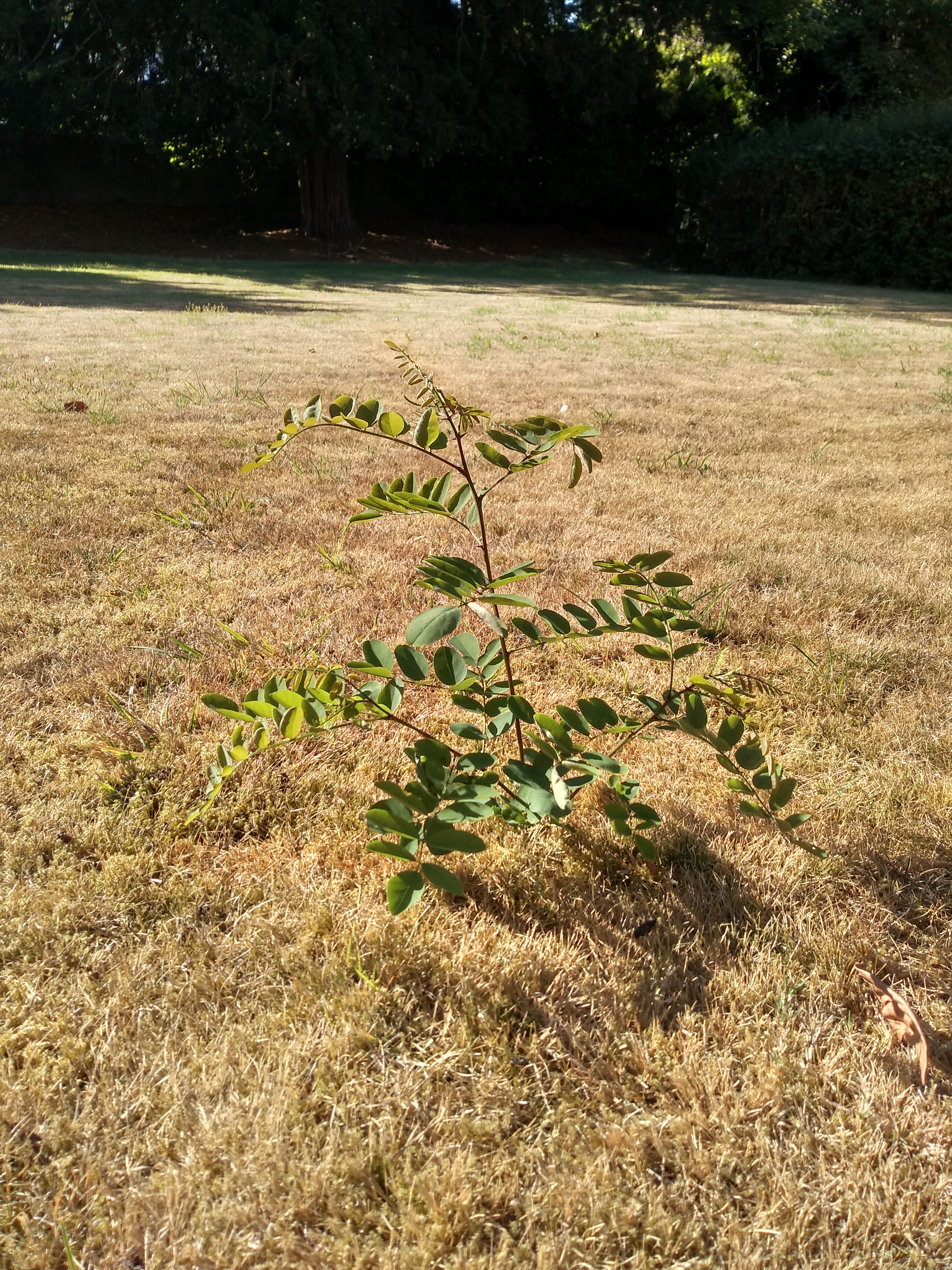 |
| Robinia seedling in a dry lawn. Frome, 5 August 2022. |
 |
| A second brood: young larvae of the Large Rose Saw-fly (Arge pagana), feeding on a wild rose. Frome, 15 August 2022. |
 |
| Housing estate verge with dropped leaves. Frome, 15 August 2022. |
 |
| Verge with leaves of Italian Alder. Frome, 15 August 2022. |
 |
| Kerb with elm leaves. Frome, 15 August 2022. |
 |
| Housing estate. Frome, 16 August 2022. |
 |
| English Elm. Frome, 20 August 2022. |
 |
| Beech leaves. Frome, 22 August 2022. |
 |
| Cherry Laurel (Prunus laurocerasus). Trowbridge, 24 August 2022. |
 |
| Silver Lime pollards damaged by fire. Frome, 21 August 2022. |
Labels: Frome, Insects, Music to listen to, Trees
Permalink posted by Michael Peverett @ 1:54 pm
0 comments

Prelude No 11 in F
Prelude No 12 in F# minor
Prelude No 13 in C minor
This is the latest batch of my preludes for guitar. There will be 24 eventually, in all the major and minor keys.
Listen to all the preludes so far, in sequence:
Enjoy!
*
Chopin's Preludes (Op. 28) were written between 1835 and 1839. The arrangement by cycle of fifths was not his invention, though. It was taken from the 24 Preludes by Johann Nepomuk Hummel (1778 - 1837), published in 1814 (Op. 67).
Many of Chopin's preludes are fairly brief, but they are all fully-formed and self-contained pieces. Hummel's preludes, on the other hand, are just expository flourishes. Often only four bars in length, a dazzle of scalework and arpeggiation, ending with big dominant-to-tonic chords. Here are all twenty-four (on today's equivalent of a pianola):
Hummel's collection, which lasts just eight minutes in total, would make no sense performed as a sequence.
Its context was the practice of preluding. A keyboard performer, before playing a main piece (a Sonata in G, say), would normally improvise a brief prelude in the same key. It told the audience to quieten down and attend; it also allowed the performer to warm up the hands, get a feel for the instrument and its projection into the room. Hummel put together his collection for the benefit of those pianists who found it difficult to improvise their own preludes.
[Information from Pei-Lin Liu's interesting 2010 thesis, available online as a PDF:
https://www.proquest.com/openview/899bd1c3cb12d8940092c36abbde682e/1?pq-origsite=gscholar&cbl=18750
.]
Incidentally Hummel's more substantial Etudes (Op. 125, c. 1834), have a different 24-key arrangement. Here too the major keys ascend by fifths, but each is paired not with its relative minor but with its parallel minor, in that respect recalling Bach's Well-Tempered Clavier. This arrangement means that the minor keys also ascend by fifths, but shifted along from the majors, so to speak.
Hummel's and Chopin's Preludes:
C major - A minor - G major - E minor - D major - B minor, etc.
Hummel's Etudes:
C major - C minor - G major - G minor - D major - D minor, etc
Here are Hummel's Etudes, performed by Mary Louise Boehm:
How to pronounce Hummel's full name. (If, like me, you are worried about showing yourself up as ignorant of classical music, but don't want to reveal your inner pedantry either...)
First, if you are going to give his first name at all, you ought to give both parts of it (i.e. "Johann Nepomuk Hummel"; it is really not OK to say "Johann Hummel"). Hummel was born near Bratislava to Austrian parents, and was named after the Czech patron saint John of Nepomuk (c. 1345 -1393), himself named after the town of his birth. John of Nepomuk was drowned in the Vltava by Wenceslaus IV.
"Johann Nepomuk" really operates as a single name, like "Gianbattista". It was a reasonably popular first name in Austria, especially among those with Bohemian connections. For instance the wind band composer Johann Nepomuk Wendt (1745 - 1801). Or Adolf Hitler's great-grandfather, the farmer Johann Nepomuk Hiedler (1807 - 1888). Or another composer (of eight symphonies among much else), Johann Nepomuk David (1895-1977).
The name has a hybrid origin, linguistically. "Nepomuk" is Czech, but "Johann" is German, not Czech (which would be "Jan"). The saint was just as popular among German-speaking Bohemians as Czech-speaking ones.
You'll pronounce "Johann" just as you pronounce it in e.g. "Johann Strauss", i.e. give the J a Y sound, but make no other effort to sound German. (Incidentally both the waltzers' names should really be "Johann Baptist Strauss", as per above, -- or, say, the Czech composer Johann Baptist Wanhal (1739 - 1813) --but here established tradition overrides accuracy.)
The pronunciation of Johann Baptist Cramer (1771 - 1858) is more moot. He was only three when his family moved from Mannheim to London, and is in all essentials an English composer. Evidently his surname was re-spelled from Kremer so English people would pronounce it correctly. Anyway, I'd go for a very English pronunciation of his first two names: maybe Johann Baptist (with a hard J) or even John Baptist. For all I know his mates called him Johnny.
Cramer's case as an ex-pat is different from Hummel's, but nevertheless it would be affected to pronounce "Nepomuk" precisely as a Czech would.
In an English language context, I'd suggest an anglicized pronunciation like nepp-uh-muke. Stress is on the first and third syllables. (In Czech the primary stress is actually on the third syllable, but mimicking that in English risks sounding pretentious.) The third syllable should be anglicized to rhyme with "Luke" (the Czech vowel sound is more boomy, similar to the way that our royal family pronounce the word "spoon"). Likewise I'd suggest it's OK to pronounce the unstressed second syllable as "uh" (schwa) -- the general fate of unstressed vowels in English. There's no need to give it the definite "o" value that it has in Czech.
A debate, obviously, that will go on and on!
Labels: Johann Baptist Cramer, Johann Nepomuk Hummel, Music to listen to
Permalink posted by Michael Peverett @ 9:42 pm
0 comments