Tuesday, March 22, 2022

Thomas Middleton and William Rowley: The Changeling (1622)

Helen Mirren as Beatrice-Joanna 

[Image source: https://whatson.bfi.org.uk/Online/default.asp?BOparam::WScontent::loadArticle::permalink=changeling . A still from the BBC TV production broadcast in January 1974.]


The great period of English tragedy was coming to an end. It was 1622, six years since Shakespeare's death and fourteen years since his last tragedy (Coriolanus). But there was still time for the Middleton and Rowley partnership to invent film noir, some three hundred years early. 

From the Moment they met it was Murder!

The ordinary couple who drop into crime would become a common motif of films like Double Indemnity (1944) and Pushover (1954). Of course Shakespeare had his own criminal couple in Macbeth, but they were senior nobility, his play was a study of greatness gone wrong. 

The Changeling was a different kind of play and Beatrice and Deflores were something new: a woman far less confident and happily integrated than her worldly position might suggest; a man fallen on hard times and compelled to bide his time in service to another. Their story didn't come from historical chronicle but from a compilation of tawdry crime stories.

*

CHristian Reader, we cannot sufficiently bewail the iniquity of these last and worst days of the world, in which the crying and scarlet-sin of Murther makes so ample, and so bloody progression . . .

Thus the Exeter merchant John Reynolds, prefacing his collection of thirty histories of God's justice in exposing and punishing murder. The first book came out in 1621, the rest by 1635. The collection was very popular. Contrary to Wikipedia and the DNB (based on Anthony Wood's Athenae Oxonienses), Reynolds was explicit that his stories were not translations. He said that he heard the stories when on his travels, and that he stuck to foreign crimes so as not to disgrace his own country. I'm not sure, but I imagine this basically means "I made them up"; it was quite a striking feat of invention in a realist mode. Reynolds had certainly used his merchant travels to equip himself with local details, e.g. in this case the imposing castle of Alicante and the church of Santa Maria. 


Illustration from a 1679 edition of John Reynolds' The Triumphs of Gods Revenge against the Crying and Execrable Sin of Murther (Book I, History IV). 

This illustrates the story according to Reynolds.

The top row shows Alsemero seeing Beatrice-Joana in the church, then presenting himself to her and her father. The second row shows her with her suitor Alfonso Piracquo (turning her head away in repulsion), then with Deflores; then Deflores murdering Piracquo. So far this is all like the familiar plot-line of The Changeling. This is not to say that there are no differences in detail and emphasis, but from this point the divergence becomes much greater. 

In Reynolds' story Deflores, though "feeding his hopes with the air of her promises" exacts no price for his service. Beatrice-Joana is married to Alsemero and has three months of wedded bliss. But then Alsemero is afflicted by causeless jealousy and takes his wife off to a confined life in Valencia. [So in fact the basic premise of Rowley's comic subplot is also taken from Reynolds; so is the name "Alibius", prominently appearing at the head of the next story (Bk I, History V).] 

When Deflores arrives with a letter from her concerned father, Beatrice contrasts his reliable  loyalty with the way her husband is now behaving towards her, and the two become affectionate. After Deflores has left, Diaphanta tips off Alsemero, who confronts Beatrice with drawn sword; she then excuses herself by telling Alsemero of Deflores' service in killing Piracquo. Alsemero is not happy, but he lets her off for now, strictly ordering her not to see Deflores any more. Nevertheless she secretly becomes Deflores' lover, and Alsemero (kept informed by Diaphanta) surprises them in bed and kills them both (third row, picture 1). Then he gives himself up to the authorities and is pardoned. 

However, Alsemero says nothing about Alfonso's murder (why?). Thomaso is convinced that Alsemero must have been an accessory and challenges him to a duel of rapiers in Alicante. Alsemero accepts the challenge (why?) but takes no chances. When they meet, he throws away his rapier and begs to be heard in his own defence. When Thomaso tosses his own rapier aside, Alsemero pulls out his concealed pistols and murders him (Row 3, picture 2). Alsemero flees but is apprehended by the authorities. He reveals the circumstances of Alfonso's death and is then executed (Row 3, picture 3). 

Reynolds underlines the point that, though Alsemero wasn't in fact active in Alfonso's murder he had been quite willing to kill Alfonso himself.  

(I used Reynolds' slightly different forms of the names in the above paragraphs.)


*

When Rowley and Middleton remodelled Reynolds' story, they ended it in reconciliation. The moral poison is centred in Deflores and Beatrice and is purged by their deaths. Alsemero has no blood on his hands, is reconciled with Tomaso and offers himself as a son to the grieving Vermandero. (To say nothing of the happy ending of the Alibius/Isabella subplot.) Nevertheless Alsemero's questionable part is still there in the play: it was after all he who first suggested getting rid of Alonzo (II.2.22).

These are the other major things that Middleton and Rowley added:

-- The whole of the madhouse subplot. 

-- Deflores' ugliness, and Beatrice-Joanna's initial loathing for him. (Deflores isn't much of a character in Reynolds, who focusses much more on Alsemero.)

-- Deflores insistence on payment in sex, with the consequence of Beatrice losing her virginity before her marriage.

-- All the subsequent transactions around Alsemero's virginity test, the bed-trick, the fire and Diaphanta's death. 

-- Beatrice's growing feeling for the man she used to hate takes on quite different meaning in The Changeling, though some details are obviously suggested by Reynolds' account. 

-- Jasperino is a new character. Diaphanta is much more of a character than in Reynolds, where she's merely a blab. 

-- Middleton and Rowley maintain the location in Alicante throughout, eliminating Reynolds' shifts of location between there and Briamata and Valencia. 


On the other hand, here are some things in Reynolds that they stuck particularly close to:

-- Alsemero's total change of plan when he glimpses Beatrice in the church, and forgets all about going to Malta (I.1).  (However Jasperino and the sailors are new creations. Also Middleton and Rowley did not bother with Reynolds' extensive account of the progress of Alsemero's courtship and his uncertainty about whether Beatrice favours him, the letters between them, etc.)

-- The circumstantial details of the murder of Alonzo (=Alfonso): the concealed sword, the removal of sword-belts to get through a narrow space, etc. (But they misunderstood some of Reynolds' detailed castle layout, and the cutting of the finger is their invention.)

-- Beatrice confiding the details of the murder to Alsemero, hoping it will save her skin (V.3). 


*


For more on John Reynolds and the Spanish setting of The Changeling, see this excellent essay:

Randall, Dale B. J. “Some New Perspectives on the Spanish Setting of ‘The Changeling’ and Its Source.” Medieval & Renaissance Drama in England, vol. 3, Rosemont Publishing & Printing Corp DBA Associated University Presses, 1986, pp. 189–216. 

https://www.jstor.org/stable/24322019


*


Pauline Wiggins' important 1897 monograph: 

An Inquiry Into The Authorship of the Middleton-Rowley Plays

https://www.forgottenbooks.com/en/readbook/AnInquiryIntotheAuthorshipoftheMiddletonRowleyPlays_10013110#0


One difference between the authors concerns feminine endings. In Middleton's verse they equal (or even exceed) one in two; in Rowley's they are about one in four. (see page 30). 

Seems straightforward. So let's check out I.1, considered a Rowley scene, using Richard Dutton's text. 

There are 234 lines in total. 31 are in prose, so effectively 203. I counted 59 feminine endings. (It's surprisingly often difficult to decide, but I tried to be as objective as I could.) 

Compare II.2, a Middleton scene. 94 feminine endings in 165 lines. 

So it checks out. Feminine endings in the Rowley scene amount to less than a third, in the Middleton scene over half. 

Wiggins points out other metrical differences. The rhythm of Middleton's lines is relatively smooth, but he's happy to tack on extra syllables at the end: 

Deflores. There's no excuse for't now, I heard it twice, madam;
That sigh would fain have utterance, take pity on't, ... (II.2.103-104)
Rowley's rhythms are more uneven. He tends to stick to ten syllables but wrench the accent.

[Beatrice-Joanna.]
[Aside] I shall change my saint, I fear me, I find
A giddy turning in me. [To Vermandero] Sir, this while
I am beholding to this gentleman,
Who left his own way to keep me company,
And in discourse I find him much desirous
To see your castle: he hath deserved it, sir,
If ye please to grant it.  (I.1.151-157) 

Apart from showing who wrote what, Wiggins' other main contention is that both authors were equally involved in the overall design of the play. Though it's naturally the Middleton scenes we remember, e.g. those incendiary two-handers between Deflores and Beatrice, yet Middleton is writing within an overall conception whose romanticism rather suggests Rowley and is notably lacking in the plays Middleton wrote on his own. 


*


The brilliant BBC production of The Changeling with Stanley Baker and Helen Mirren, broadcast in January 1974. I was fifteen, so it had a very formative effect. I was amazed, watching it again last week, how I still seemed to recall every gesture, tone and kiss; and it's still difficult for me to see the action of the play any other way. 

Deflores/Baker was the unquestioned hero in my eyes, finding his way to sexual fulfillment in the face of a woman's implacable disdain (a situation I could well relate to). Which is troubling, since what Deflores does is rape that woman (isn't it so?); and Deflores never regrets what he's done because his joy outweighs all ills, and Beatrice comes to approve his masterly handling and voluntarily seek his comfort, and the play itself approves him because it agrees that she deserved her fate. The Changeling embodies a base anti-feminist male fantasy, from that point of view. But the view is too narrow. Beatrice, seeking to have her will within the highly authoritarian constraints of her society and her father, holds our attention. She remains as resourceful after Deflores' harsh lesson as before, as powerful when dying condemned as when influencing events in the opening scene. Like her "good" double Isabella, and even the bumptious Diaphanta, Beatrice contributes to a sense that the realism of The Changeling actually has a proto-feminist aspect, as in Women Beware Women. (This paradoxical combination of macho abusive males and strikingly powerful women runs through a lot of film noir, too.)

At just over 1hr 40mins, the BBC production was quite a speedy re-handling. The main plot is allowed to flow without interruption up to Deflores arranging Piracquo's after-dinner tour (II.2), before we get our first glimpse of the madhouse (based on I.2). Then follows the murder and, without a break, the scene in which Deflores exacts his reward (III.4). Now comes the second madhouse scene (some of III.3 -- Franciscus is omitted, and this Isabella seems to respond positively to Antonio's kisses). Then the main plot takes over again, with just a brief sight of the madmen's dance (the end of IV.3), inserted before V.3.

Ah, those good-natured madhouse scenes. Most modern performances of The Changeling have found it impossible to include them in full. They seem to operate at a different tempo to the rest of the play, and of course in a very different mode. Lollio, very likely played by Rowley himself (if the jokes about his bulk are any indication), is a kind of master of ceremonies, on stage almost throughout but with no real stake in what's happening. There are some indications that the contemporary popularity of The Changeling may have been due principally to this part of the play. In the study, at least, it works very well, if only to build anticipation by forcibly suspending the hurtling momentum of the main plot, and to underline the latter's darkness by sunny parodies of the same situations (it's as if Shakespeare had intercut Macbeth with scenes from The Merry Wives). Whatever, Rowley's strange ideas about subplots result in a highly intertextual play. The two authors must have worked very closely together.

*

Middleton: A Chaste Maid in Cheapside:
Middleton: Women Beware Women:

Complete list of posts on Shakespeare and his contemporaries


Labels: , ,

Thursday, February 17, 2022

Thomas Middleton, A Chaste Maid in Cheapside (1613)

Moll and Touchwood Junior's first attempt to marry (III.1)

[Image source: https://www.angelfire.com/realm/mine2/johncastle/A_Chaste_Maid_in_Cheapside.html . From William Gaskill's production at the Royal Court in 1966. Moll was played by Barbara Ferris, Touchwood Junior by John Castle, and the Parson by Roger Booth.]


Moll

I suppose that Moll is the "chaste maid" of the title; at any rate no-one else fits that description. Chastity being apparently a rare commodity in Cheapside, she's pursued by Touchwood Junior and Sir Walter Whorehound, not as just another lay but as a wife. 

MAUDLINE.
      Have you played over all your old lessons
      O' the virginals?
MOLL.                      
                                  Yes. 

(I.1.1-2)

The Oxford editor prints this as verse, like all the play except for some passages that are wholly or partly in Latin. Actually it's a flexible medium that sometimes has the swing of verse but very often doesn't. Anyway, Moll's monosyllabic reply leaves the half-line hanging expectantly. Her mother is not impressed:

MAUDLINE.
      Yes? You are a dull maid o'late, methinks;
      You had need of somewhat to quicken
      Your green sickness -- Do you weep? -- a husband.  ...

That might be true, but Moll's taciturnity continues all through the play. For instance, her one-line commentary on the final scene is "I am silent with delight" (V.4.46-47). Touchwood Senior says she'll be voluble enough to the maid servants now she's mistress of her own house. He seems almost embarrassed. 

Sir Walter, her intended, addresses her several times, but she never says a word to him. She is, in fact, as shy of speaking to strangers as Ward in Women Beware Women. Like him she's an adolescent. She speaks only to her mother, her father, her lover and his brother. Her longest speech is four lines (V.2.25-28). She does sing a song in the same scene; it's the only time she might appear a romantic heroine, but she's singing it because of her mother's badgering, and disclaims it immediately. Most of the time neither her parents nor her lover are particularly keen for her to speak. Touchwood Junior, sure of her "blood" (i.e. desire) wants her to silently absorb messages and to respond with her "liking in three words", and her parents order her about. But despite her lack of speech, she's quite active. She's driven by feeling, but is minimalist in her verbal expression of it.  Typical speeches by Moll:

O death! (I.1.109)

O, were I made of wishes, I went with thee! (I.2.200)

Good sir, do; we cannot be too safe. (IV.3.27)


The play even emphasizes this silent centre to a very verbal play. When Allwit asks who Sir Walter means to marry, Davy Dahumma replies: "E'en the same was gossip, and gave the spoon" (III.2.198). That's apparently enough to identify her to Allwit, who met her in II.3. But we never see Moll with the other gossips, nor giving a spoon. Maybe it's the gilt one that Sir Walter presents with other gifts (III.2.38), but Sir Walter gives the impression that all the gifts are from him alone. 

As a virtually wordless adolescent, Moll brings together many other elements in the play. As still half a child who calls all men "Sir" she connects to the infants with which the play abounds (including two on stage, presumably represented by dolls), and to Nick and Wat, two of the seven Allwit children. Perhaps she would not be much more at ease with the gossips than her brother Tim is.

But as an impassioned sexual being she also connects with a lot of the adult goings-on. And as a supposedly subservient daughter, she connects with the various servants and maids who glide around the background of the play. There are no elderly people here. Sir Oliver talks in an elderly way but his youth is magically restored when his wife becomes pregnant. When Sir Walter starts to have premonitory thoughts about death, he is promptly ejected from the comedy by the Allwits, who retain their own presence in it by unstinted material drive. The world of the play is one of "getting", it has no room for the thoughts of age. 

Middleton might have originally intended to call her Mary (as in one speech prefix), signifying chastity. But if he did he soon switched to the nickname version Moll, which already had a racy association (as in Allwit's "molls and dolls" (II.2.64) -- compare those later heroines Moll Flanders and Molly Bloom). (And of course it matches the hints of her mother's name "Maudline".)

Moll's name is only used twice in the spoken text, by her mother during the scene where Moll "dies" (V.2). It's a token of affection that's only skin deep. When Moll sings the song she requested, Maudline's enjoyment of the music makes her forget about its dire context. After Moll is "dead", her parents' sorrow is comically brief: there is the practical matter of limiting reputational damage, and the consolation of their son Tim's imminent wedding. (Meanwhile Tim's chief concern is Moll's dying too quickly, before he has written his Latin epitaph.) 

Moll is pulled about a lot. The scene where her mother drags her on stage by her hair is distasteful to Sir Walter's sensibilities (and to the boatmen, and to Yellowhammer). Nevertheless, the suggestion is that mother and daughter understand each other very well:

MOLL. 
      O, my heart dies!
MAUDLINE. 
                                   I'll make thee an example
      For all the neighbours' daughters. 
MOLL.       
                                                             Farewell, life!
MAUDLINE. 
      You that have tricks can counterfeit. 

(IV.4.21-23)

Well, yes, Moll undeniably does have tricks and she does counterfeit. Maudline knows it, because she was just the same and sometimes still is. You want something, you go for it.  

Actually, it's a tough call to pick the most distasteful moment in a play that revels in slipping them past us with sunny insouciance. I think I would choose Moll's father's reflections on her fiancee being revealed as an arrant whoremaster.  

YELLOWHAMMER. 
      Well, grant all this, say now his deeds are black,
      Pray, what serves marriage, but to call him back;
      I have kept a whore myself, and had a bastard,
      By Mistress Anne, in anno --
      I care not who knows it; he's now a jolly fellow,
      H'as been twice warden, so may his fruit be,
      They were but base begot, and so was he;
      The knight is rich, he shall be my son-in-law,
      No matter so the whore he keeps be wholesome,
      My daughter takes no hurt then, so let them wed,
      I'll have him sweat well e'er they go to bed.

(IV.1.237-247)

No doubt the Yellowhammers are keen to benefit from their economic property as soon as decently possible. Tim, at Cambridge, might be 18 and Moll (we tend to assume, illogically) about the same age. But Tim is sexually backward, Moll is not. 

By the same vague process of assimilation, we assume that Touchwood Junior is not so very much younger than Touchwood Senior, who has evidently been married quite a long time. Mid-twenties, anyway. But like Moll he isn't notable for florid language. To Sir Walter's elegant anger he replies rather haplessly: 
                                          Like enough, sir.
     You have ta'en me at the worst time for words
     That e'er you picked out: faith, do not wrong me, sir.

(III.1.52-54)

When the lovers meet their speech is functional, almost arguing with each other in the excitement.

TOUCHWOOD JUNIOR
                                  What made you stay so long?
MOLL
     I found the way more dangerous than I looked for.
TOUCHWOOD JUNIOR
     Away, quick! There's a boat waits for you; and I'll
     Take water at Paul's wharf ....

(IV.3.23-26)
     

When Touchwood Junior says "O sir, if ever you felt the force of love, / Pity it in me" (III.1.1-2), he's evidently laying it on thick to get the Parson on side. I can't think of any Jacobean play that's more firmly focussed on sex, but A Chaste Maid doesn't speak the language of passion: that's relegated to the songs. 

Touchwood Junior has been accused of taking a basely material view of his relationship with Moll 

                                                    her blood's mine,
      And that's the surest. Well, knight, that choice spoil
      Is only kept for me.   [He catches Moll's attention from behind.]
MOLL
                                       Sir?
TOUCHWOOD JUNIOR
                                               Turn not to me
      Till thou may'st lawfully; it but whets
      My stomach, which is too sharp-set already.

(I.1.134-138)

But it doesn't sound as if Moll and he are out of harmony on this. They have an understanding, so enough of the flimflam. And besides, there's the matter of concealment. "Love that's wise / Blinds parents' eyes" (I.1.186-187).

At any rate, Touchwood Junior isn't in the same class as his rival when it comes to sexual materialism. Here he tots up his prospects:

SIR WALTER
                                    I never was so near my wish
     As this chance makes me: ere tomorrow noon 
     I shall receive two thousand pound in gold
     And a sweet maidenhead worth forty. 

(IV.4.47-50)

Perhaps Sir Walter when he says this is already showing some signs of revulsion from the whole business. Nevertheless it's brutal. 

Touchwood Junior doesn't make such explicit reference to the gold that comes with Moll, but he is certainly aware of it: "an you'll follow my suit and save my purse too", he says to his brother, egging him on in the outrageous scheme to disinherit Sir Walter by assisting the childless Kixes. 

After all, the Touchwood brothers are cash-strapped. Touchwood Junior manages to buy a fine wedding-ring, but he has to ask Touchwood Senior to stump up for the license. Understated as his expression is, he does seem to love Moll primarily for herself, or for her body anyway. But the Yellowhammers' wealth is a fact of life. 


Moll and Touchwood Junior


[Image source: https://www.thestage.co.uk/reviews/a-chaste-maid-in-cheapside . Press photo (not credited, but probably by Bethany Blake) for the 2015 production by Mercurius at the Rose Playhouse, London, directed by Jenny Eastop. Moll was played by Beth Eyre and Touchwood Junior by Harry Russell.]


Online text of A Chaste Maid in Cheapside, on Chris Cleary's valuable site:
https://tech.org/~cleary/chast.html . It puts completions of verse lines in the left margin, as Middleton himself was apparently wont to do. Richard Dutton, in the Oxford English Drama text I've been reading (1999), lays them out in the orthodox way: i.e. a speech that starts midway through a line of verse is  indented. Not that the lines often bear much meaningful resemblance to verse, as I mentioned before. 


Mrs Allwit and the gossips (III.2)


[Image source: https://www.theguardian.com/stage/2020/feb/20/frances-cuka-obituary . From William Gaskill's production at the Royal Court in 1966. Mrs Allwit was played by Frances Cuka.]

I've been dipping into JStor's resources A Chaste Maid in Cheapside. Here's a few papers that I enjoyed reading. 

Chatterji, Ruby. “Theme, Imagery, and Unity in ‘A Chaste Maid in Cheapside.’” Renaissance Drama, vol. 8, [University of Chicago Press, Northwestern University], 1965, pp. 105–26, http://www.jstor.org/stable/41913895.  Useful for parallels across Middleton's wider oeuvre, and I was struck by the glancing reference to Wycherley. Chatterji's characterizations of the Allwit's household, and of the Yellowhammer parents, are interesting, because I read them both a bit differently. She implies that in 1965 the play had yet to be revived: that was about to change. 

Wigler, Stephen. “Thomas Middleton’s ‘A Chaste Maid in Cheapside’: The Delicious and the Disgusting.” American Imago, vol. 33, no. 2, The Johns Hopkins University Press, 1976, pp. 197–215, http://www.jstor.org/stable/26303131. "In A Chaste Maid in Cheapside (as in most Middleton plays), delight and distaste perpetually contaminate one another." Considers the relentless nature of Middleton's content and language, and the discomforts of laughing along with what Wigler calls the "comic-grotesque". 

Huebert, Ronald. “Middleton’s Nameless Art.” The Sewanee Review, vol. 95, no. 4, Johns Hopkins University Press, 1987, pp. 591–609, http://www.jstor.org/stable/27545804. A lively account of Middleton's major plays. A Chaste Maid is characterized as a play about sexual management and mismanagement. Particularly insightful on the striking character of Allwit, I thought. Also interesting is his remark that Middleton is the "first great secular playwright in English drama" (some other commentators have linked him with Puritanism). Huebert ends: "I think he is serving a warning, not about what will happen to sinners in the hands of an angry God, but about what we are capable of doing to one another and to ourselves".

Van Den Broek, A. G. “Take the Number Seven in Cheapside.” Studies in English Literature, 1500-1900, vol. 28, no. 2, [Rice University, Johns Hopkins University Press], 1988, pp. 319–30, https://doi.org/10.2307/450555. I don't quite concede to the theory about the symbolic significance of the number seven, but this is a vivid  reading of the play which considers aspects of the action that are often overlooked. For instance the possible hint of Allwit's reformation in his final lines, and whether Touchwood Senior will continue to increase the size of the Kix family. An acute suggestion about Allwit's name, too: it is not just a reversal of "wittol". 

*


Labels:

Monday, January 17, 2022

Thomas Middleton, Women Beware Women (1613-14 or 1619-23?)


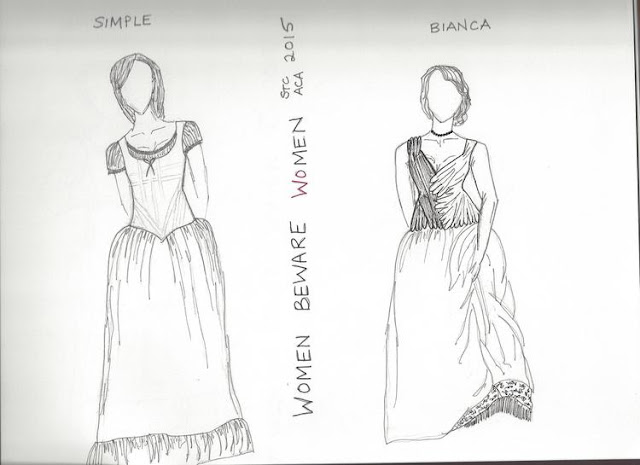
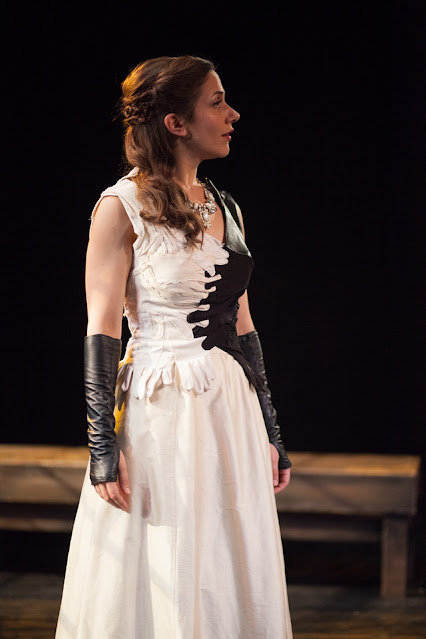
Julie Cray Leong's costumes for Bianca


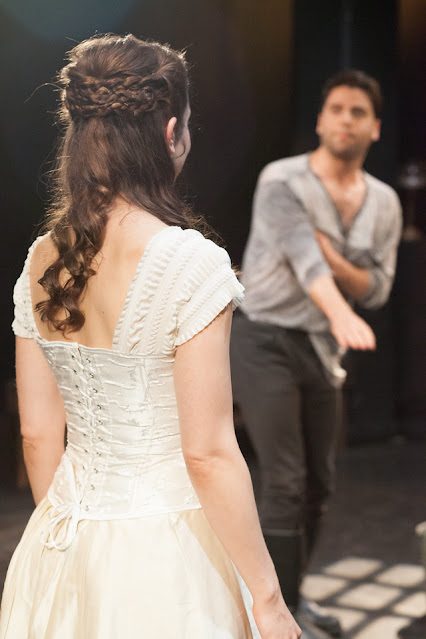
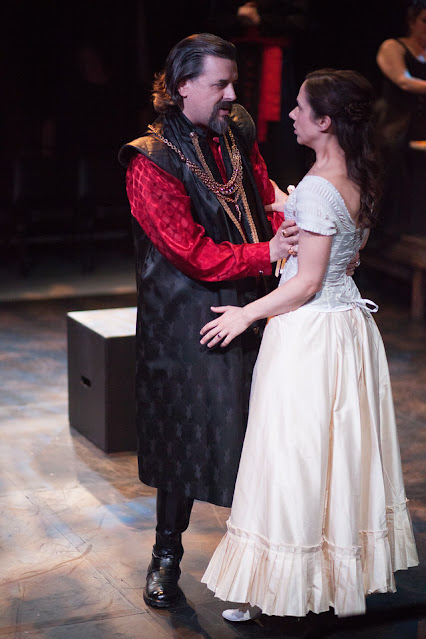
[Image source: http://juliecraycostumes.com/women-beware-women . All images from the site of costume designer Julie Cray Leong, for a Shakespeare Theater Company / Academy for Classical Acting production of Women Beware Women (c. 2016: I couldn't find any details of the actors). Initially Bianca wore a simple white dress. Later she wore a richer dress that graphically showed the Duke's hands all over her.]


I'd better emphasize that I'm embarrassingly ignorant of Thomas Middleton's writing. Lots of it is extant: see for instance the many plays on Chris Cleary's very useful site:  https://tech.org/~cleary/middhome.html . One of the few that isn't available there, unfortunately, is Women Beware Women. (There is a plain online text here: https://www.poetryexplorer.net/poem.php?id=10107691 .) Given the ignorance, I of course have no hope of saying anything here that hasn't already been said.

The fact is, I come to Middleton with a bucketload of prejudices. I'm passionate about Shakespeare, but if I can't read Shakespeare I'd rather read plays by early contemporaries: Marlowe and Kyd, for instance. Those who had the poor taste to insist on continuing to write plays when Shakespeare had already scaled the heavens don't get much of a look in with me. At least until we are safely into another era altogether (i.e the Restoration). 

But, well, it's hardly Middleton's fault that he was sixteen years younger than Shakespeare. And actually it's fascinating how divergent Women Beware Women is from Shakespeare's conception of tragedy. It arrives at a serious engagement with human questions but it goes about it in ways that seem quite alienating to a Shakespeare fan, a refusal of expected naturalism, a withholding of confidences about the characters we're watching.

*


MOTHER. Thy sight was never yet more precious to me;
Welcome with all th' affection of a mother,
That comfort can express from natural love!
Since thy birth-joy—a mother's chiefest gladness,
After sh'as undergone her curse of sorrows—
Thou wast not more dear to me than this hour
Presents thee to my heart: welcome again!

LEANTIO [Aside]. 'Las, poor affectionate soul, how her joys speak to me!
I have observ'd it often, and I know it is
The fortune commonly of knavish children
To have the lovings't mothers. 

MOTHER.                                What's this gentlewoman?

LEANTIO. O, you have named the most unvaluedst purchase
That youth of man had ever knowledge of!
As often as I look upon that treasure,
And know it to be mine . . .

[Act I, Scene 1, lines 1-31]


So it starts, rather slowly. A Romeo and Juliet come back to reality after a romantic elopement, but romance is left behind, and this Romeo, crucially, is not from a house "alike in dignity".

Leantio is apparently a man whom women are fond of, and his mother's greeting is effusive. It's odd that his first words are an aside. Middleton has no qualms about freezing the action for an aside, at any moment. (Isabella even has an aside in the middle of performing the masque (V.2.102-105), with the eyes of the on-stage audience upon her.) 

This particular aside registers Leantio's guilty consciousness that he's about to disappoint his mother when she learns of his equivocal behaviour. Is he really knavish? Middleton's drama doesn't really interest itself in individual character or inherent moral status but in how people behave in given circumstances of class and economy. In these circumstances both Leantio and his mother understand Bianca as a prize beyond the expectations of their modest place in society. Leantio tries to emphasize to his mother that it's a vast stroke of good fortune. (Leantio is a "factor", a merchant's agent -- which, we infer, is why he went to Venice.) His mother isn't taken in by Leantio's braggadoccio. She says (what he probably knows already, but won't admit) that Bianca is a prize he should not have collected, it will be beyond him to hold on to her -- and so indeed it proves. [Perhaps she remembers what happened to the factor Lorenzo in Decameron IV.5, source of Keats' Isabella.]

Leantio's insecurity is apparent: he doesn't want his mother going on about what wives might reasonably expect, in case it awakens "spirits" in Bianca, or persuades her to act by "the licentious swindge of her own will". 

Despite the insecurity, he allows himself to imagine that theirs will be a perfect bourgeois household full of children, the envy of the barren rich. But Leantio's often rather browbeaten way of talking about life doesn't suggest he's really cut out for happiness.

Bianca is eloquently silent during this long colloquy. When she does finally speak, it's to say just such compliant things as Leantio would wish. It looks too good to be true, and hints that Bianca, not Leantio, controls the course of events here. Not in herself, but in the fact of her superior condition, that can't just be wished away.  There's an economic instability in the situation. 

[BIANCA ...] I have forsook friends, fortunes, and my country,
And hourly I rejoice in't: here's my friends,
And few is the good number.   

She means just Leantio and his mother (who has not in fact been especially welcoming). This can't last. 

[John Mc Elroy and Ann Christensen write very well about this opening scene -- links below.]

Love or lust is an economic fact that has to be accommodated in one way or another, but lies beyond explanation. What did Bianca see in Leantio? And later, what does Livia see in Leantio? Why does Hippolito, who could pick and choose, desire his own niece? No answer is offered. The play is interested in what these desires lead to, but not in why they settled on one person or another. And especially how they lead to the inexorable logic of money transactions. "All preferment / That springs from sin and lust, it shoots up quickly", Leantio comments (III.2.47); and a few lines later, Livia says smugly "I have enough to buy me my desires" (III.2.63). 

The play that begins in this modest lodging will end in a festivity at the highest end of Florence society. That movement is a large part of what the play's about. The festivity is of course strewn with corpses. There's an element of cautionary tale in this particular tragedy. And yet after all it's a lot of fun. A comitragedy, an ensemble piece (rather well plotted and structured: consider how all the main characters receive about the same amount of focus): it ought to be easy, I fancy, for a company to turn Women Beware Women into an absorbing evening's entertainment.


*

Here's a schematic of who kills who in Women Beware Women:


DUKE   

Sets up the death of Leantio (IV.1). 

Killed by Bianca (accidentally) (V.2).

BIANCA 

Promotes the death of Leantio: because she surely anticipates this outcome when she recounts his "dangerous" behaviour to the Duke in IV.1. This isn't 100% certain, but the natural inference to be drawn from her emphatic "I love peace, sir" is that she senses what the Duke's going to do and wants to  underscore her approval of by all means necessary. 

Attempts to kill the Cardinal but fails. Accidentally kills the Duke instead (V.2). 

Kills herself (V.2).

LEANTIO

Threatens Bianca (and the Duke, in absentia) with a vengeance that sounds like it might take the form of violence (IV.1). 

Killed by Hippolito (IV.2)

HIPPOLITO

Kills Leantio (IV.2). Applauds Isabella's killing of Livia (V.2). 

Killed by Guardiano (V.2) who has applied poison to the Cupids' arrows, though Hippolito actually finishes the job himself by running onto the guard's weapon. 

ISABELLA

Kills Livia (V.2) with poisoned smoke. 

Killed by Livia (V.2) with flaming gold.

LIVIA

Kills Isabella (V.2) with flaming gold.

Killed by Isabella (V.2) with poisoned smoke. 

GUARDIANO

Conspires with Livia to kill Hippolito and Isabella (IV.2), and instructs Ward in some of the details (V.1). 

Posthumously kills Hippolito with his plan B (the poisoned arrows). (V.2)

Killed by falling into his own trap (intended for Hippolito) (V.2)

WARD

Co-opted by Guardiano to assist in killing Hippolito (V.1), though as usual it's unclear how fully Ward grasps what's going on. 

Runs away (V.2) and survives. 

CARDINAL

Could his mention of "vengeance" at the end of IV.3 indicate a personal impulse to resort to violence against the Duke/Bianca (which is what Bianca seeks to pre-empt). But given his genuine sorrow at their demise (V.2) this seems unlikely. 

Survives assassination attempt by Bianca (V.2)

*

These events come thick and fast at the end. I wanted to check my impression that virtually everyone who gets killed is also a killer, at least in intention. 

The exception, probably, is Leantio (from whose death all else follows). His wild words do express vengeful hatred towards Bianca and the Duke, but they don't suggest that he has formulated any definite plan. Despite his innocence in that regard, his death doesn't arouse much sympathy in us. 

*

And yet Women Beware Women isn't just black comedy. There are times when a different kind of tension holds us, a horrified interest in Livia telling lies to her niece to persuade her into incest, for instance. Above all, the chess scene (II.2) where Bianca is prised away by Livia and Guardiano and subjected to the Duke's implacably calm powerplay (rape ? seduction ? no single word really covers it; King David's claim of Bethsabe in Peele's David and Bethsabe is a pretty close parallel). 

But we have to maintain a quite difficult stance, of pity for the victims (both as themselves, and as representative of all others snared in this way) balanced by observations that significantly reduce our good will toward them. An Isabella who is apparently not bothered that her lover thinks he's committing incest. A Bianca who embraces her role as the Duke's mistress with increasing enthusiasm and ruthlessness. 


Bianca and Leantio

[Image source: http://juliecraycostumes.com/women-beware-women .]

I found these useful (in chronological order):

Charles A.Hallett, “The Psychological Drama of Women Beware Women”, Studies in English Literature, 1500-1900, vol. 12, no. 2, [Rice University, Johns Hopkins University Press], 1972, pp. 375–89, https://doi.org/10.2307/449900. Illuminatingly argues for the importance of the concept of cynicism in the play. That is, an accommodation to circumstances, a feeling that no moral values are worth upholding. Interprets Livia's behaviour as arising from ingrained cynicism, and sees Bianca as tragically plummeting into cynicism when the Duke's authority overwhelms her. 

John F. Mc Elroy, “The White Devil, Women Beware Women, and the Limitations of Rationalist Criticism.” Studies in English Literature, 1500-1900, vol. 19, no. 2, [Rice University, Johns Hopkins University Press], 1979, pp. 295–312, https://doi.org/10.2307/450210.  Percipient about Leantio's character and on the balance in the play between the simple judgments of a comic mode and a more serious way of seeing the action. But suggests that our coolness of response to Middleton's characters (e.g. their deaths don't affect us with horror or pity) is a limitation of the author's approach.

Anthony B. Dawson, “Women Beware Women and the Economy of Rape”, Studies in English Literature, 1500-1900, vol. 27, no. 2, [Rice University, Johns Hopkins University Press], 1987, pp. 303–20. Writes powerfully about the economic determinism that makes Bianca embrace her new role as the Duke's mistress, and also inhibits the freedoms of Isabella and Livia. Sees the crazy denouement as a failure to fully realize the insights of the earlier part of the play, as many others do. (A view I'd dissent from, as does Ann Christensen.)

Ann C. Christensen, “Settling House in Middleton’s ‘Women Beware Women.’” Comparative Drama, vol. 29, no. 4, Comparative Drama, 1995, pp. 493–518. On the failed households in the play, and contemporary tension between public and private spheres, e.g. Leantio's perception of an opposition between going out to work and keeping a home.


Bianca and the Duke

[Image source: http://juliecraycostumes.com/women-beware-women .]

I suppose if I say that Middleton is no poet then I betray a very limited idea of poetry, but I think you'll know what I mean. His verse looks like it was written fast and with minimal interest in being "poetic", though it's often pithy, observant and forceful. It's an excellent vehicle for a continuous subtle movement of ideas and assertions (both true and deceptive); it allows the drama to flow vividly. But it doesn't throw up many anthologizable flowers. You can go on for pages without ever being recalled to the fact that you're reading iambic pentameters (which anyway he's often pretty casual about, metrically speaking). 

Still, I'll have a go at an anthology, one quote from each character.


FABRITIO

On with your mask, for 'tis your part to see now
And not be seen. Go to, make use of your time;
See what you mean to like; nay, and I charge you,
Like what you see. Do you hear me? There's no dallying,
The gentleman's almost twenty, and 'tis time
He were getting lawful heirs, and you a-breeding on 'em. [I.2.74-79]

ISABELLA

                         Oh the heart-breakings
Of miserable maids, where love's enforced!
The best condition is but bad enough:
When women have their choices, commonly
They do but buy their thraldoms, and bring great portions
To men to keep 'em in subjection --
As if a fearful prisoner should bribe
The keeper to be good to him, yet lies in still,
And glad of a good usage, a good look sometimes. ...  [I.2.164-172]

MOTHER

                       Trust me, y'are too blame,
His absence cannot last five days at utmost.
Why should these tears be fetched forth? Cannot love
Be e'en as well expressed in a good look,
But it must see her face still in a fountain? 
It shows like a country maid dressing her head
By a dish of water.                             [I.3.65-71]

GUARDIANO

The Duke himself first spied her at the window;
Then in a rapture, as if admiration
Were poor when it were single, beckoned me,
And pointed to the wonder warily
As one that feared she would draw in her splendour
Too soon, if too much gazed at.           [II.2.8-13]

LIVIA

I know y'are alone too; why should not we
Like two kind neighbours, then supply the wants
Of one another, having tongue-discourse,
Experience in the world, and such kind helps
To laugh down time, and meet age merrily?  [II.2. 148-152]

DUKE

I am not here in vain; have but the leisure
To think on that, and thou'lt be soon resolved.
The lifting of thy voice is but like one
That does exalt his enemy, who proving high
Lays all the plots to confound him that raised him.
Take warning, I beseech thee; thou seem'st to me
A creature so composed of gentleness,
And delicate meekness -- such as bless the faces
Of figures that are drawn for goddesses,
And makes art proud to look upon her work --
I should be sorry the least force should lay
An unkind touch upon thee.          [II.2.332-343]

BIANCA

Make me not bold with death and deeds of ruin
Because they fear not you; me they must fright.
Then am I best in health. Should thunder speak
And none regard it, it had lost the name
And were as good be still. I'm not like those
That take their soundest sleeps in greatest tempests;
Then wake I most, the weather fearfullest,
And call for strength to virtue.       [II.2.349-356]

LEANTIO

Oh thou the ripe time of man's misery, wedlock,
When all his thoughts, like over-laden trees,
Crack with the fruits they bear, in cares, in jealousies.
Oh that's a fruit that ripens hastily,
After 'tis knit to marriage; it begins
As soon as the sun shines upon the bride
A little to show colour.                  [III.1.271-277]

HIPPOLITO

Come, my life's peace. I have a strange office on't here:
'Tis some man's luck to keep the joys he likes
Concealed for his own bosom, but my fortune
To set 'em out now, for another's liking --
Like the mad misery of necessitous man
That parts from his good horse with many praises,
And goes on foot himself . . .        [III.2.189-195]

SORDIDO

Troth, I think, master, if the truth were known,
You never shot at any but the kitchen-wench,
And that was a she-woodcock, a mere innocent,
That was oft lost and cried, at eight and twenty. [III.3.20-23]

WARD

Her father praised her breast, sh'had the voice forsooth; I marvelled she sung so small indeed, being no maid. Now I perceive there's a young chorister in her belly -- this breeds a singing in my head, I'm sure. [IV.2.116-119]

CARDINAL

                       Is this the best
Amends that sin can make after her riots?
As if a drunkard, to appease Heaven's wrath,
Should offer up his surfeit for a sacrifice? 
If that be comely, then lust's offerings are
On wedlock's sacred altar. (IV.3.19-24)     

*


From what I've seen, commentators tend to regard Ward with particular revulsion. I have a rather different impression. I see him as an adolescent who isn't formed into an adult, as someone who is impossibly shy of communicating to any purpose with the adults, but only with his sidekick Sordido. (Naturally he isn't shy with his guardian either, merely drives him mad by constantly fooling around.) He still lives in a world of play, and -- given what the rest of the play shows us -- is refreshingly free of a consciousness of himself as an economic entity. Certainly his self-centredness and obscenity does expose the brute reality that lies beneath the machinations of the other characters, but, in Ward's own case, words are not matched by deeds; he's an ineffective imitator of the adepts (just as when he imitates Hippolito's dancing). His inspection of Isabella is grotesque, but it's Isabella who means to exploit Ward, not vice versa. For all the vain boasting his own sexual experience is minimal (III.3.21-22) and I don't imagine he'd do anything about being pre-emptively "cuckolded" except to sulk and play cat-and-trap. Guardiano is evidently of the same opinion. 

GUARDIANO: Speak, hast thou any sense of thy abuse? Dost thou know what wrong's done thee?
WARD: I were an ass else -- I cannot wash my face, but I am feeling on't. 
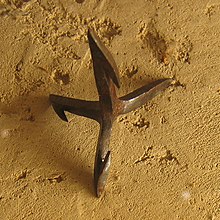
GUARDIANO: Here, take this galtrop, then; convey it secretly into the place I showed you; look you, sir, this is the trap-door to't. (V.1.1-6)


A caltrop or "galtrop" (V.1.5)

[Image source: Wikipedia .]


A simple but effective defensive weapon. I haven't managed to source an image of a seventeenth-century one (the one above is apparently Roman, though I find that hard to believe), but the basic tetrahedral design has remained the same for two thousand years. 

You scattered caltrops on the ground as, especially, a defence against mounted troops. It doesn't seem very plausible to me that Hippolito -- or, as it turns out, Guardiano himself -- would actually die from tumbling onto a caltrop. Perhaps we're meant to think that Guardiano poisoned the tips of the caltrop, just as he did with the Cupids' arrows.  


Fruit of the prostrate Mediterranean plant known as Caltrops (Tribulus terrestris), well known to people who walk barefoot.


Caltrops, painfully extracted from my hand after using it to keep my balance on a sand dune near Torrevieja.


Bianca's new dress

[Image source: http://juliecraycostumes.com/women-beware-women .]

I've been reading Women Beware Women and other plays, edited by Richard Dutton in the Oxford English Drama series (1999). 

I paid a pound for it, which I thought was good value to discover Middleton through four of his best plays, and I still think so. But Middleton calls for many explanatory notes, about a dozen per page. I have no problem with the content of these notes, but their format makes extricating the content a hideous business. I've read them all, and I still wonder if it's someone's idea of a joke.


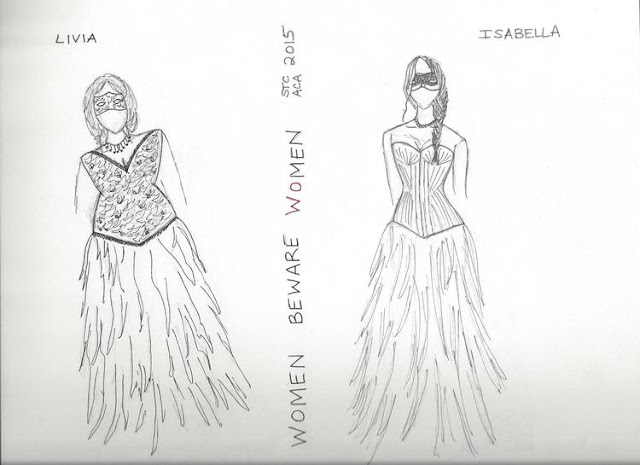
Julie Cray Leong's costumes for Livia and Isabella

[Image source: http://juliecraycostumes.com/women-beware-women .]

*

Middleton: A Chaste Maid in Cheapside:
Middleton: Women Beware Women:

Complete list of notes on Shakespeare and his contemporaries:


Labels:

Thursday, February 04, 2021

these notes on Shakespeare

Olivia and Viola/Cesario

[Image source: https://www.alleytheatre.org/press/twelfth-night-photos . Photo by Lynn Lane. Elizabeth Bunch as Olivia and Kim Blanck as Viola in a 2018 Alley Theatre Production of Twelfth Night, directed by Jonathan Moscone, at the Hubbard Theater, Houston.]


I've got no particular excuse,  I'm certainly not a specialist, but I just love writing about Shakespeare. I realized that some people might like to have all the links together in one place, so here's a list that I'll keep up to date. It's a relief to discover that there's still a lot of plays I haven't written about. I still have Twelfth Night ahead of me!


1. On individual plays and poems:

[I'm listing Shakespeare's works in approximately chronological sequence, but I'm not being too strict about it.  For instance, in the first tetralogy I place Henry VI Part 1 first, even though I think it was written last. Oh yes, and "Shakespeare" sometimes means "Shakespeare and Others".]

The Rape of Lucrece
https://michaelpeverett.blogspot.com/2018/04/towards-collatia.html
Sonnet 1
https://michaelpeverett.blogspot.com/2018/06/but-as-riper.html
Sonnet 29
https://michaelpeverett.blogspot.com/2020/10/like-to-lark.html
Sonnet 81
https://michaelpeverett.blogspot.com/2014/01/william-shakespeare-sonnet-81.html
Titus Andronicus
https://michaelpeverett.blogspot.com/2015/11/william-shakespeare-and-george-peele.html
Love's Labour's Lost
https://michaelpeverett.blogspot.com/2014/01/william-shakespeare-loves-labours-lost.html
King John
https://michaelpeverett.blogspot.com/2014/02/william-shakespeare-king-john-1595.html
Romeo and Juliet
https://michaelpeverett.blogspot.com/2014/01/william-shakespeare-romeo-and-juliet-c.html
The Merchant of Venice
https://michaelpeverett.blogspot.com/2014/03/william-shakespeare-merchant-of-venice.html
Much Ado About Nothing
Henry V
https://michaelpeverett.blogspot.com/2025/04/alexander-great.html
The Merry Wives of Windsor
Troilus and Cressida
https://michaelpeverett.blogspot.com/2021/04/a-choice-of-pandars.html
Othello
https://michaelpeverett.blogspot.com/2016/07/othello-and-king-lear.html
Measure For Measure
https://michaelpeverett.blogspot.com/2014/03/william-shakespeare-measure-for-measure.html
https://michaelpeverett.blogspot.com/2017/09/the-moral-cleanup-in-measure-for-measure.html
King Lear
and Nahum Tate's History of King Lear: 
Pericles, Prince of Tyre
Cardenio


2. On more general Shakespeare topics:


3. On what others have written about Shakespeare:


4. On other dramatists of Shakespeare's time:

[But I'm including Dryden, because of the close connection of All For Love with Antony and Cleopatra.]

George Peele: David and Bethsabe
Thomas Middleton: A Chaste Maid in Cheapside
Thomas Middleton: Women Beware Women
Thomas Middleton and William Rowley: The Changeling


5. On other poets of Shakespeare's time:

Sir John Davies


Labels: , , , , ,

Powered by Blogger